
2026's Essential AI Competitive Intelligence Platform for Pharma Landscape Analysis
What separates a real AI competitive intelligence platform from a faster search box — capabilities, data sources, use cases, vendor selection, and compliance.
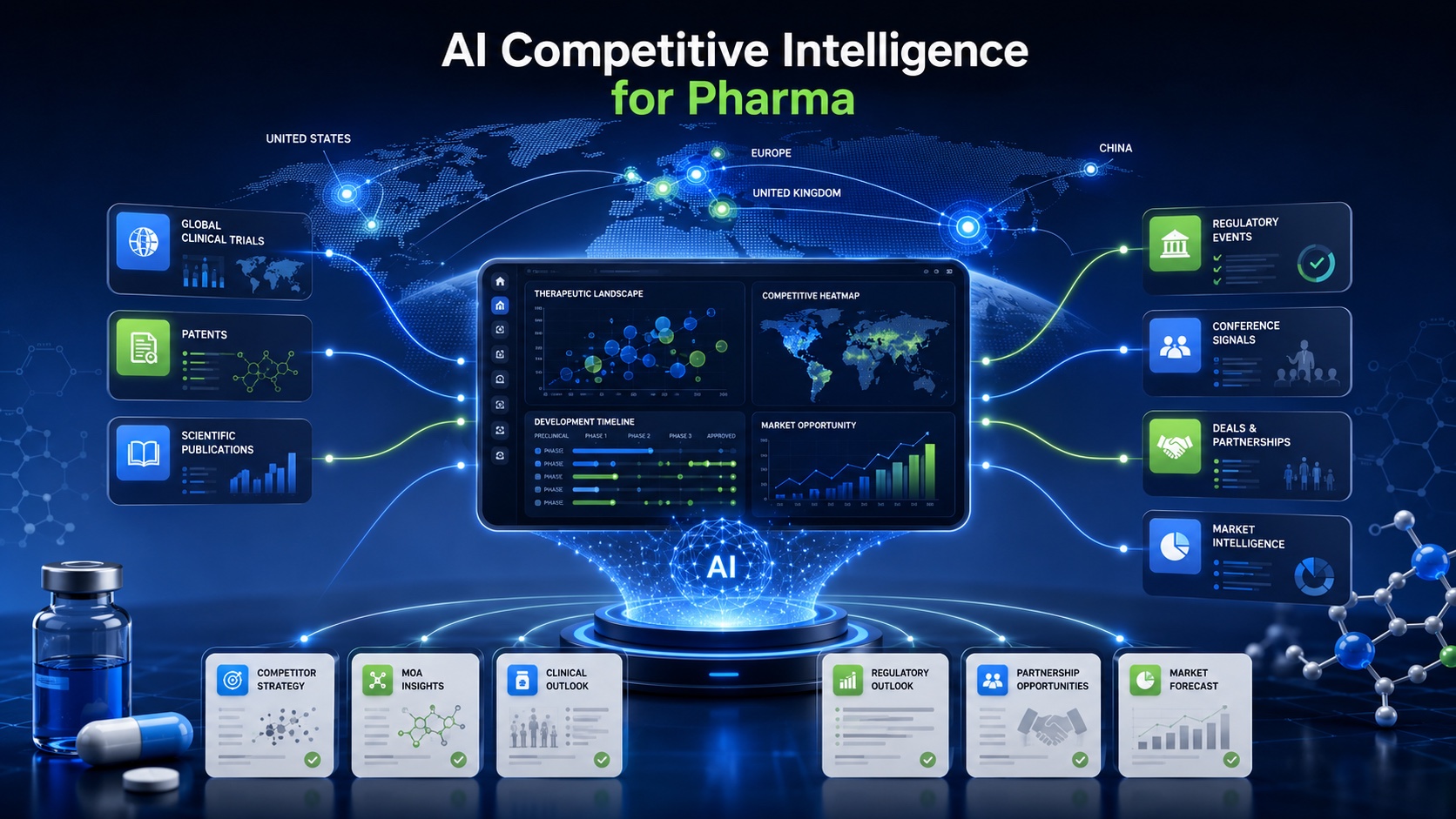
Pharmaceutical competitive intelligence leaders face a growing challenge: turning vast, fragmented, fast-changing data into defensible insights before the window to act closes.
AI competitive intelligence platforms address that challenge by automating data collection, signal detection, analysis, and synthesis across clinical, regulatory, scientific, patent, conference, deal, and market sources.
In 2026, the right AI-CI platform does more than make search faster. It helps biopharma teams move from reactive monitoring and static reports to continuous, decision-ready intelligence — whether they are tracking competitor pipelines, assessing emerging therapies, evaluating assets, or preparing for a portfolio decision. This guide explains the essential capabilities, data strategies, use cases, vendor-selection criteria, and future trends shaping AI-driven pharma competitive intelligence.
The role of AI in pharma competitive intelligence
Artificial intelligence transforms pharmaceutical competitive intelligence by automating the collection, analysis, and synthesis of datasets that are too large and fragmented to monitor manually. Competitive intelligence in pharma includes the systematic tracking and interpretation of competitors, therapeutic assets, preclinical R&D pipelines, clinical trials, deals, regulatory events, scientific developments, and market dynamics.
Traditional CI workflows often depend on repeated database searches, spreadsheet reconciliation, manual literature review, and periodic slide updates. AI-native platforms can continuously monitor new clinical-trial records, patent filings, conference presentations, publications, regulatory milestones, and company disclosures — then connect those signals and explain their strategic significance.
That shift matters because static quarterly reporting is poorly suited to a market in which a competitor can change a trial, publish new data, announce a partnership, or secure a regulatory designation overnight. The strongest AI-CI platforms help teams detect early signals, validate findings against primary sources, and brief decision-makers quickly. The result is not simply more information; it is faster, better-supported decision-making across competitive intelligence, portfolio strategy, business development, and R&D.
Key capabilities of AI competitive intelligence platforms
Leading AI competitive intelligence platforms for pharma go well beyond keyword search or generic business intelligence. They are designed to handle the scientific complexity, global scope, and evidence standards of biopharma landscape analysis. Core capabilities include:
- Continuous signal detection and monitoring — The platform monitors clinical-trial registries, patents, regulatory sources, scientific publications, conferences, company announcements, and other relevant sources for meaningful changes.
- Large-scale scientific synthesis — Advanced language models analyze papers, patents, trial records, abstracts, and disclosures at scale while preserving links to the underlying evidence.
- Global clinical-trial intelligence — Comprehensive coverage across major global and regional trial registries allows teams to track development activity in the United States, Europe, the United Kingdom, China, and other key markets — not just the records visible in a single database.
- Entity resolution and evidence linking — The platform recognizes that one asset may appear under multiple names, sponsors, subsidiaries, indications, or registry identifiers and connects those records into a coherent view.
- KOL identification and network analysis — Teams can identify relevant experts and examine their publications, affiliations, trial involvement, and relationships to companies or assets.
- Workflow automation — Repeatable research templates and monitoring workflows can produce competitor profiles, indication landscapes, asset assessments, target product profiles, clinical development analyses, and stakeholder-ready summaries.
- Internal and external knowledge integration — Proprietary documents, notes, and internal research can be analyzed alongside external evidence within a governed workspace.
- Transparent, source-linked outputs — Important claims should be traceable to their supporting sources so analysts can validate the evidence and apply their own judgment.
| Capability | Benefit |
|---|---|
| Continuous signal detection | Earlier warning of competitor and market changes. |
| Global clinical-trial analysis | A more complete view of assets, studies, geographies, sites, and development strategies. |
| Scientific and patent synthesis | Faster review of large, complex evidence sets. |
| Entity resolution | Fewer missed records and less duplicate analysis. |
| Custom reports and dashboards | Decision-ready outputs tailored to each stakeholder. |
| KOL and network mapping | Identification of influential researchers and relationships. |
| Workflow automation | Less manual work and more consistent analysis. |
| Source-level traceability | Faster validation and greater confidence in conclusions. |
Even the strongest AI platforms do not eliminate the need for human expertise. AI accelerates research and synthesis; experienced CI, clinical, scientific, and commercial professionals provide contextual judgment, challenge assumptions, and translate evidence into strategy.
Data sources powering pharma landscape analysis
The quality of a pharma AI-CI platform depends on more than the number of sources it claims to cover. Breadth, geographic depth, update frequency, normalization, and traceability all determine whether the resulting analysis is useful. Major external data categories include:
- Global and regional clinical-trial registries.
- Patent databases and regional intellectual-property offices.
- Peer-reviewed literature and preprint servers.
- Medical and scientific conference abstracts and presentations.
- Regulatory filings, designations, labels, and approvals.
- Company press releases, investor materials, and securities filings.
- Drug, target, disease, and molecular-structure databases.
- Licensing, partnership, financing, and M&A announcements.
- Epidemiology, sales, pricing, and forecast datasets.
- Region-specific sources, including Chinese clinical, regulatory, scientific, company, and digital channels.
Why comprehensive global clinical-trial coverage matters
No single clinical-trial registry provides a complete global view. Studies may be registered in different jurisdictions, updated at different times, described using inconsistent terminology, or duplicated across registries. A platform that relies primarily on one U.S. source can miss important development activity, particularly in China and other fast-moving markets.
One Zyme provides comprehensive global clinical-trial coverage and analysis across major international and regional sources, including key U.S., European, UK, Chinese, and multinational registries. It goes beyond retrieving trial records by harmonizing asset names, sponsors, indications, phases, endpoints, enrollment, locations, status changes, and development timelines. This allows teams to:
- Identify trials and competitors that would be missed by searching only one registry.
- Compare study design, endpoints, eligibility criteria, enrollment, comparators, and geographic strategy.
- Detect meaningful amendments, delays, status changes, and new trial starts.
- Reconcile duplicate or inconsistent records across registries.
- Connect trial activity with publications, conference data, regulatory events, patents, and company disclosures.
- Analyze global and China-specific development strategies in a single workflow.
The distinction is important: clinical-trial coverage answers “What studies exist?” Clinical-trial analysis answers “What is changing, how do the programs differ, and what does it mean for our strategy?”
Internal and external data
| Data type | Examples | Strategic value |
|---|---|---|
| Internal | Proprietary research, diligence materials, CRM data, call notes, clinical documents, prior reports. | Preserves institutional knowledge and adds company-specific context. |
| External | Trial records, publications, patents, regulatory documents, company disclosures, conference materials, market data. | Provides an up-to-date view of the external landscape. |
High-quality platforms do not merely aggregate these sources. They harmonize terminology, de-duplicate records, resolve entities, and maintain provenance. Matching the same drug candidate across trial registries, patent filings, conference abstracts, and company announcements requires domain-specific normalization — not just general web search.
This is why data quality remains a central barrier to effective AI adoption. Platforms that combine rigorous source selection, continuous quality assurance, transparent citations, and repeatable validation workflows produce more reliable intelligence than systems built on raw, unverified feeds. For biopharma organizations, the ability to analyze proprietary knowledge alongside comprehensive external evidence creates a more useful intelligence layer for R&D, portfolio strategy, CI, and business development.
Strategic use cases for pharma competitive intelligence
AI competitive intelligence platforms create the most value when they support high-impact decisions rather than isolated searches. The following use cases show how teams can move from raw signals to strategic action.
Early competitor signal detection and rapid response
AI-CI platforms monitor competitor activities such as new trial starts, enrollment or status changes, patent applications, regulatory submissions, data readouts, and partnership announcements. Earlier detection gives teams more time to reassess clinical strategy, update forecasts, refine positioning, or investigate an emerging asset.
Global clinical pipeline tracking and decision-making
By combining global trial records with regulatory milestones, publications, conference data, patents, and company disclosures, teams can build a more complete view of competitor pipelines. They can compare development programs across regions, identify gaps or crowding in an indication, evaluate differentiation, and prioritize internal development or in-licensing opportunities.
One Zyme is particularly useful when the answer depends on reconciling fragmented evidence across geographies. Its coverage of the United States, Europe, the United Kingdom, China, and other key markets helps global teams analyze an asset's full development footprint rather than treating each registry or region as a separate research project.
Automated scientific, regulatory, and conference analysis
Instead of manually reviewing hundreds of papers, abstracts, regulatory documents, or conference updates, AI-CI platforms can produce structured analyses that highlight the evidence, key changes, competitive implications, uncertainties, and questions requiring expert review.
Search and evaluation and asset diligence
Business development and search-and-evaluation teams can use AI to identify relevant assets, screen opportunities against defined criteria, build landscapes, compare clinical and scientific differentiation, assess deal context, and prepare investment-committee materials. The best platforms make these processes repeatable without forcing every project into a rigid template.
Portfolio, TPP, and clinical-development workflows
AI-CI platforms can connect external evidence to recurring strategic deliverables such as target product profiles (TPPs), clinical development plans (CDPs), indication assessments, competitor profiles, and portfolio reviews. This reduces time spent gathering and reformatting evidence and gives experts more time to challenge assumptions and make decisions.
Commercial forecasting and scenario analysis
When clinical, regulatory, epidemiological, pricing, and competitor assumptions are transparent, AI can help teams structure market forecasts, test scenarios, identify the variables driving an outcome, and update the model as new evidence appears. Forecasts should distinguish sourced facts from assumptions and make uncertainty visible rather than present a single number as certainty.
Across these use cases, the platform's value lies in compressing the path from question to validated, decision-ready output.
Challenges and compliance in pharma AI-CI adoption
AI competitive intelligence creates significant value, but adoption introduces technical, operational, governance, and trust challenges. Organizations should evaluate these issues before scaling a platform across high-stakes workflows.
Data quality and normalization
Incomplete, inconsistent, duplicated, or outdated source data can lead to unreliable conclusions. Effective platforms need robust entity resolution, source prioritization, freshness controls, and quality assurance — especially when analyzing assets across languages and jurisdictions.
Integration complexity
Connecting an AI-CI platform to document repositories, CRM systems, data warehouses, and proprietary research requires technical planning and clear governance. Buyers should distinguish between a vendor's general API claims and its ability to support the specific data sources and workflows their teams use.
Security, privacy, and regulatory fit
Requirements depend on the intended use and the data being processed. Evaluation criteria may include:
- GDPR and other privacy laws — Appropriate controls for personal data, international transfers, retention, and access.
- Enterprise security — Encryption, role-based access, auditability, incident response, and independent security assurance.
- Customer-data protections — Clear commitments that customer content is not used to train shared models, along with appropriate retention controls for model providers and subprocessors.
- GxP and 21 CFR Part 11 considerations — Validation, electronic-record, audit-trail, and data-integrity requirements when a specific workflow falls within a regulated environment.
- EU AI Act governance — Transparency, documentation, oversight, and risk-management obligations appropriate to the system's classification and use.
Not every CI workflow involves protected health information, GxP records, or a high-risk AI system. The correct standard is not a generic compliance checklist; it is a documented fit between the platform, the organization's policies, the data involved, and the intended decision workflow.
Human oversight and validation
AI can miss evidence, confuse similarly named assets, misread a source, or overstate a conclusion. High-stakes outputs therefore require source-level traceability and human review. Strong platforms help experts validate conclusions quickly by showing where each important claim came from and separating sourced facts from inference.
Organizations that combine data governance, clear validation standards, cross-functional ownership, and user training are best positioned to realize the value of AI-CI without creating avoidable risk.
Vendor landscape and selection criteria in 2026
The pharma AI-CI landscape includes AI-native research platforms, legacy life-science databases, commercial analytics products, and specialized scientific tools. Many vendors solve only one part of the workflow, such as patent search, trial tracking, or forecasting. Buyers should evaluate whether they need another database, a point solution, or an AI teammate that can connect evidence across workflows. Representative solutions for pharma competitive intelligence include:
- One Zyme — An AI-native platform built specifically for biopharma CI, business development, search and evaluation, clinical, R&D, and portfolio teams. One Zyme combines comprehensive global preclinical and clinical-trial coverage and analysis with scientific literature, patents, regulatory information, company and deal activity, conference data, and region-specific intelligence — including deep coverage of China. Teams can investigate ad hoc questions, conduct deep research, reuse structured templates, analyze internal materials, and generate source-linked deliverables within one platform.
- Cortellis (Clarivate) — A long-established life-sciences intelligence suite covering areas such as pipelines, clinical trials, patents, deals, and regulatory data.
- Evaluate — A commercial intelligence platform focused on forecasting, consensus data, deal analysis, and pipeline tracking.
- Specialized scientific and patent tools — Point solutions can offer deep functionality for particular modalities, targets, intellectual-property questions, or scientific datasets, but may need to be combined with other systems to support end-to-end CI workflows.
Vendor selection checklist
| Criterion | Key question |
|---|---|
| Data breadth and depth | Does the platform connect clinical, scientific, patent, regulatory, conference, company, and market evidence? |
| Global preclinical and clinical-trial coverage | Does it provide comprehensive coverage across the markets that matter, including China, and reconcile records across registries? |
| Analytical depth | Can it compare programs, explain changes, surface gaps, and answer strategic questions — or only retrieve records? |
| Source traceability | Can users quickly validate important claims against primary evidence? |
| Domain expertise | Was the product designed around pharmaceutical terminology, entities, workflows, and evidence standards? |
| Workflow flexibility | Can teams handle both ad hoc questions and repeatable deliverables such as landscapes, TPPs, CDPs, and monitoring reports? |
| Internal-data integration | Can proprietary documents and institutional knowledge be analyzed securely alongside external sources? |
| Security and governance | Do the platform's controls, data practices, and subprocessors fit enterprise requirements? |
| Customization and integration | Can outputs, templates, taxonomies, and integrations adapt to the organization's workflows? |
| Time to value | Can users produce a useful, validated output quickly without months of implementation or specialist query training? |
Critical evaluation questions:
- Ask the same difficult, real-world question of each vendor and compare coverage, accuracy, citations, depth, and usability.
- Test whether the platform finds trials and assets across multiple regions rather than relying on a single registry.
- Check whether it distinguishes verified facts, estimates, assumptions, and strategic inference.
- Review how it handles ambiguous asset names, subsidiaries, licensing changes, and duplicate records.
- Determine how easily a team can turn an analysis into a repeatable monitoring or reporting workflow.
- Ask how the vendor measures quality, incorporates user feedback, refreshes data, and corrects errors.
Organizations evaluating AI competitive intelligence platforms should prioritize domain-specific systems that can demonstrate performance on their own use cases. The right partner will combine modern AI, broad evidence coverage, life-sciences expertise, transparent sourcing, and enterprise-grade data practices.
Integrating AI-CI into pharma decision workflows
Deploying an AI competitive intelligence platform is only the first step. Value is realized when intelligence becomes part of recurring R&D, CI, portfolio, business-development, and commercial decisions.
Step-by-step integration framework
- Start with a consequential, repeatable workflow. Choose a process with a clear owner, known pain points, and measurable output — such as a competitor landscape, weekly monitoring report, indication assessment, or asset screen.
- Connect the relevant internal and external evidence. Define the documents, databases, registries, and sources needed for the decision. Normalize the entities and terminology that matter to the team.
- Configure the analysis and monitoring approach. Establish the questions, inclusion criteria, tracked competitors, geographies, output format, and signals that should trigger an update.
- Generate stakeholder-ready outputs. Tailor the depth and format to the audience, whether the deliverable is an analyst brief, executive summary, evidence table, dashboard, or decision memo.
- Validate with the right experts. Require reviewers to confirm material facts, challenge interpretations, and document important assumptions or uncertainties.
- Embed the output into the decision process. Use the analysis in portfolio reviews, diligence meetings, clinical-strategy discussions, competitive-response planning, and executive updates.
- Measure and improve. Track time saved, evidence coverage, error rates, user adoption, decision-cycle time, and whether the output changed or accelerated a decision.
From periodic reports to living intelligence
Best-in-class CI functions are moving from one-off research and quarterly updates to living intelligence. Teams should be able to ask a new question when conditions change, refresh a prior analysis with new evidence, and monitor the assumptions that matter most. That continuity is especially valuable in global clinical development, where trial activity, regulatory events, and competitor strategies evolve across markets at different speeds.
Maximizing ROI through workflow adoption
Successful adoption depends on more than platform access. Organizations need clear workflow ownership, shared validation standards, reusable templates, and feedback loops between users and the vendor. By treating AI-CI as a strategic operating capability — not another database subscription — teams can reduce repetitive research, improve consistency, and make better use of scientific and commercial expertise.
Future trends in pharma competitive intelligence platforms
The next generation of pharma AI-CI will be defined less by chat interfaces and more by the ability to maintain context, monitor change, reason across evidence, and support complete decision workflows.
Autonomous, agentic research
AI agents will increasingly execute multi-step research plans: searching diverse sources, resolving entities, testing hypotheses, identifying missing evidence, and updating structured outputs. The useful distinction will be between systems that merely generate fluent text and systems that reliably complete a research workflow with transparent evidence.
Knowledge graph-driven reasoning
Knowledge graphs connect assets, targets, diseases, sponsors, trials, sites, investigators, patents, deals, regulatory events, and market outcomes. Combined with language models, these relationships support more precise questions and help users understand why a new signal matters within the broader competitive landscape.
Multimodal and multilingual intelligence
Important evidence is spread across tables, figures, posters, slide decks, PDFs, websites, and multiple languages. Platforms will improve at interpreting these formats together. Multilingual and region-specific coverage will become increasingly important as innovation and clinical development grow across China and other markets that are often underrepresented in Western data products.
Continuous intelligence and personalized monitoring
Static dashboards will increasingly give way to living analyses that update as underlying evidence changes. Instead of sending every possible alert, platforms will learn which competitors, events, assumptions, and thresholds matter to each team and explain the significance of the change.
Greater demand for validation and measurable ROI
Enterprise buyers will demand clearer evidence of accuracy, coverage, auditability, security, and business impact. Vendors will need to show not only that their models perform well, but that their systems help teams complete real workflows faster and make better-supported decisions.
Human expertise will remain essential
As automation improves, human review will shift from finding and formatting information toward evaluating evidence, challenging assumptions, and making strategic choices. The strongest platforms will make that expert work easier — not obscure it behind unsupported conclusions.
For biopharma organizations planning their AI-CI roadmaps, the priority should be an AI-native platform that combines comprehensive global evidence, domain-specific analysis, source transparency, workflow flexibility, and strong data governance.
Frequently asked questions
What is an AI competitive intelligence platform for pharma?
An AI competitive intelligence platform for pharma monitors and analyzes competitor pipelines, clinical trials, scientific developments, patents, regulatory events, deals, conferences, and market activity. It turns fragmented evidence into source-linked insights that support faster decisions across CI, R&D, portfolio strategy, and business development.
How does AI improve pharma landscape analysis?
AI can search, connect, compare, and synthesize large evidence sets much faster than manual research. It helps teams identify relevant assets and signals, compare development programs, explain competitive implications, and produce structured outputs while preserving access to the underlying sources.
Why is global clinical-trial coverage important?
No single registry captures every trial worldwide, and records often differ across jurisdictions. Comprehensive global coverage reduces the risk of missing competitors or studies and gives teams a more complete view of development strategy across the United States, Europe, the United Kingdom, China, and other markets.
How does One Zyme analyze global clinical trials?
One Zyme brings together clinical-trial information from major global and regional sources, harmonizes key entities and fields, and connects trial activity with publications, conference data, patents, regulatory events, and company disclosures. Teams can compare programs, track meaningful changes, and analyze global and China-specific development strategies in one workflow.
What types of data do AI competitive intelligence platforms use?
They can combine clinical trials, publications, patents, conference materials, regulatory documents, company disclosures, deals, market data, and internal company knowledge. The most useful platforms normalize these sources and link every important conclusion back to supporting evidence.
How do AI platforms differ from traditional keyword-search tools?
Keyword-search tools primarily return records that match entered terms. AI-native platforms can interpret a strategic question, search across data types, resolve entities, compare evidence, identify gaps, and generate a structured, cited analysis tailored to a decision.
How can AI competitive intelligence platforms accelerate decision-making?
They reduce the time required to find, reconcile, analyze, and format evidence. Teams can detect competitor moves sooner, refresh analyses as conditions change, and spend more time interpreting the implications instead of collecting data.
What should pharma teams evaluate before choosing an AI-CI platform?
Teams should test data coverage, global clinical-trial depth, analytical quality, source traceability, domain expertise, workflow flexibility, internal-data handling, security, integration, and time to value using real questions from their own work.
Why is human oversight still necessary?
AI can miss evidence, misread sources, confuse entities, or overstate conclusions. Expert review remains essential for validating important facts, interpreting uncertainty, and turning evidence into accountable strategic decisions.
See One Zyme's landscape analysis in action
Bring a competitor, indication, or asset you already know well — and see what One Zyme surfaces against it.