
Best AI Tools for Biopharma Commercial and BD Teams Compared
Every AI vendor promises faster diligence and smarter decisions. Here's a plain, four-dimension comparison of the five categories BD and commercial teams actually evaluate.
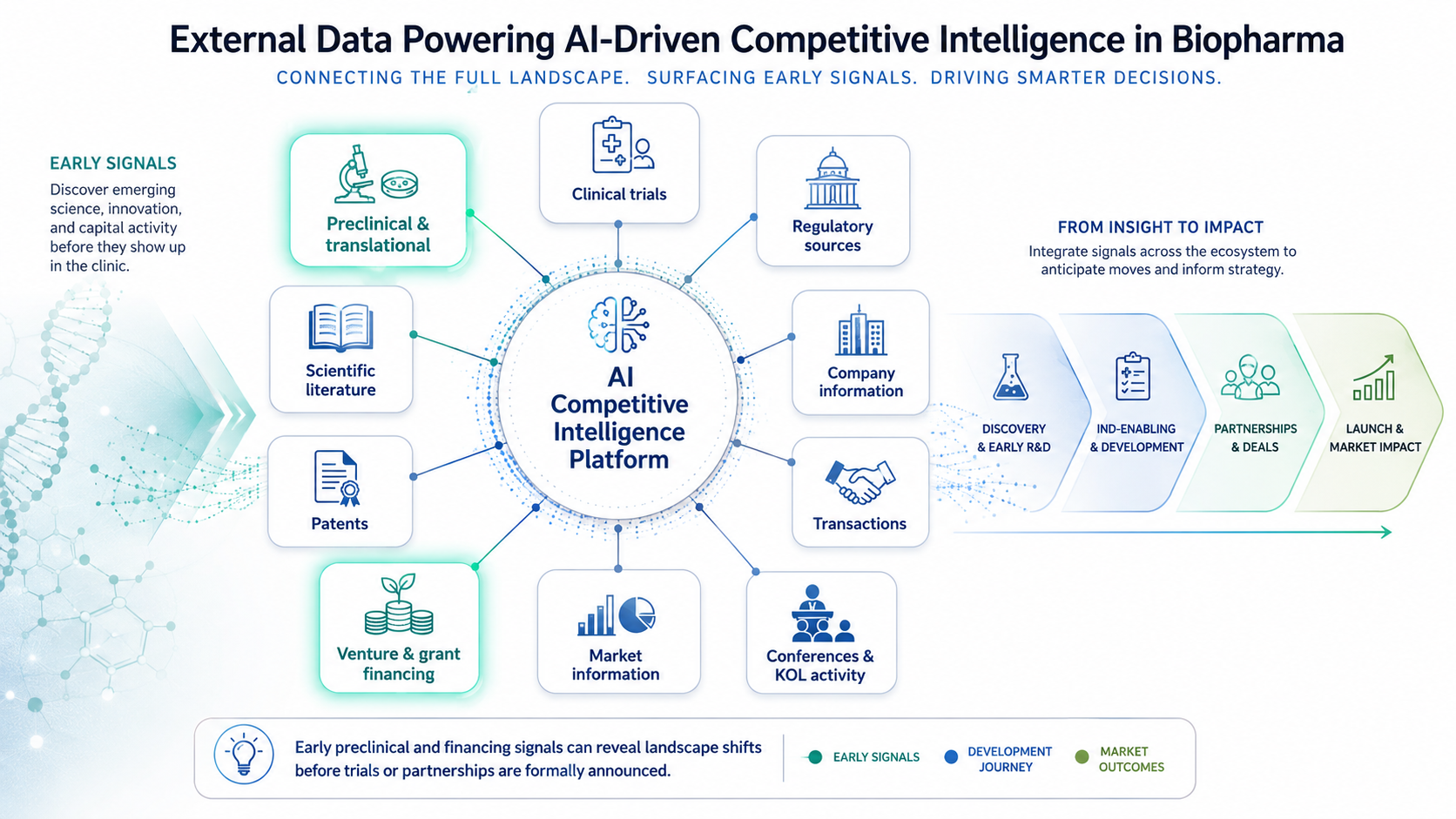
Business development and commercial teams in biopharma do not have a data shortage. They have a synthesis, timing, and decision-making problem — and a market full of AI tools that all sound roughly the same.
Clinical registries, preclinical research, patents, regulatory filings, company disclosures, venture and grant financing, conference presentations, and internal diligence notes hold an enormous amount of relevant signal. But those sources are fragmented, update at different speeds, and are hard to interpret together. The right AI tool should close that gap: continuously monitor the landscape, connect evidence across sources, and turn signals into sourced conclusions that support licensing, partnering, and portfolio decisions.
So which AI tool is best for a biopharma BD or commercial team? There is no single answer for every organization. The best tool is the one that combines the right data depth, output quality, compliance posture, integration, and price for the decisions your team actually makes. A large source count or an impressive language model is not enough. Below, we compare the five categories of AI tool a BD team is likely to shortlist across the four criteria that separate them.
How to compare AI tools for biopharma BD
Vendors describe themselves in similar language, so it helps to fix a rubric before the first demo. For BD and commercial diligence, four dimensions do most of the work:
- Output quality — Can the tool interpret trial design, preclinical evidence, mechanisms, patents, financing, and transaction structures well enough to produce a stakeholder-ready analysis — not just retrieve documents? Is every important claim traceable to its supporting source?
- Compliance and governance — How is your data stored, isolated, processed, and retained? Are audit trails, source dates, reviewer workflows, and correction mechanisms available for high-stakes outputs?
- Integration — Can it analyze proprietary materials — diligence files, CRM records, forecasts — alongside external data while respecting document permissions, and does it fit the way your team already works?
- Pricing and total cost — Beyond the license, what does it cost in analyst time, reconciliation across systems, and implementation before it delivers value?
None of these should be judged in isolation. Real-time monitoring is less useful when entity resolution is poor. Powerful synthesis is dangerous when the evidence cannot be inspected. A broad database creates limited value when users must still perform every analytical step by hand.
The five categories of AI tool BD teams evaluate
Most tools a BD team will shortlist fall into one of five categories. Each has a characteristic strength and a characteristic limitation.
| Category | Typical strength | Common limitation |
|---|---|---|
| Traditional life-science data provider | Curated datasets, historical depth, established enterprise relationships. | Expensive, fragmented interfaces, limited synthesis, and periodic rather than continuous analysis. |
| Horizontal enterprise AI or search platform | Internal-document search, broad integrations, general-purpose usability. | Limited biopharma ontology, uneven scientific reasoning, and incomplete specialist data. |
| Point solution | Deep functionality in one domain — patents, trials, forecasting, literature, or financing. | Requires users to reconcile results across multiple systems. |
| Consulting or managed intelligence service | Expert interpretation and customized deliverables. | Slower turnaround, higher marginal cost, and limited continuous self-service. |
| AI-native biopharma platform | Cross-source synthesis, natural-language workflows, monitoring, and rapid custom analysis. | Quality, data depth, and auditability vary substantially by vendor. |
The right choice may involve more than one category. The goal is not necessarily to replace every existing source immediately — it is to eliminate unnecessary fragmentation and manual work while improving the speed and quality of decisions.
Comparing the five on the criteria that matter
Here is how the categories tend to compare across the four BD dimensions. Treat this as a starting hypothesis to test against your own use cases, not a verdict — individual vendors within a category vary widely.
| Tool category | Output quality | Compliance & governance | Integration | Pricing model |
|---|---|---|---|---|
| Traditional data provider | Reliable structured data; synthesis and interpretation left to the analyst. | Mature certifications and processes. | Strong external coverage; limited native use of internal documents. | High, multi-seat enterprise licenses. |
| Horizontal enterprise AI / search | Strong general writing; weaker on specialized biopharma reasoning. | Enterprise-grade security; governance geared to general use. | Excellent internal-document integration and connectors. | Per-seat SaaS; low entry cost. |
| Point solution | Best-in-class in one domain; narrow outside it. | Varies by vendor and domain. | Deep in its niche; adds another system to reconcile. | Moderate, per-domain subscriptions that stack up. |
| Consulting / managed service | High, expert-reviewed deliverables. | Handled contractually by the provider. | Customized to the engagement; not continuous self-service. | Highest marginal cost; project- or retainer-based. |
| AI-native biopharma platform | Cross-source, sourced synthesis when built for the domain. | Varies by vendor — ask for audit trails and human-review controls. | Combines external and internal data with permissioning. | Platform subscription; priced against replaced work. |
Output quality: retrieval is not synthesis
The most important shift for a BD team is from periodic intelligence to continuous intelligence. A tool that only retrieves documents may save search time. A tool that identifies what changed, explains why it matters, compares a program against the existing landscape, and distributes that analysis to the right stakeholders can change how the team operates.
In practice, output quality comes down to whether the system can reliably move from data → signal → interpretation → decision. Test it directly: ask the tool to analyze a landscape your team already knows well, then push it into an obscure or newly changing area where superficial data coverage is likely to fail. Watch whether it reconciles aliases, subsidiaries, and asset codes; whether it distinguishes historical status from current status; and whether every important comparison can be traced to its evidence.
Compliance and governance for BD workflows
Several frequently cited requirements have narrower scopes than vendor marketing sometimes implies. For most BD buyers the practical question is not “Is this AI tool compliant?” but “Is this specific use of the tool appropriately controlled for its data, users, outputs, and regulatory context?”
- GDPR governs the processing of personal data and can affect internal documents, KOL information, and cross-border transfers — it does not automatically apply to every public competitive-intelligence record.
- HIPAA protects certain individually identifiable health information for covered entities and business associates; a tool working only with public pipeline information may not handle protected health information, but internal use cases should be assessed individually.
- The EU AI Act uses a risk-based framework; it entered into force in 2024 and became broadly applicable in August 2026, with exceptions and extended timelines for certain high-risk systems.
- GxP and 21 CFR Part 11 apply to specific regulated records and good-practice contexts; applicability depends on the records being created, maintained, or submitted rather than serving as a blanket certification of the software.
Because generative models can produce unsupported conclusions or convert ambiguous information into confident prose, source-level citations, reviewer controls, clear uncertainty, and human validation matter as much as any certificate. Ask how customer data is stored, isolated, retained, and protected — and whether specialists can correct entities, challenge conclusions, and approve high-stakes outputs.
Integration: external plus internal, with permissions intact
The strongest BD tools do more than place sources in one interface. They harmonize terminology, remove duplicates, preserve publication dates, distinguish historical information from current status, and make the origin of each conclusion clear. Just as important, they analyze proprietary materials — asset evaluations, deal-team notes, CRM records, forecasts, and strategy documents — alongside external evidence while respecting document permissions and confidentiality.
Integration also means fit with recurring decisions. A report that stays outside the decision process has limited value, regardless of its quality. Look for a tool that can be embedded in quarterly portfolio reviews, external-innovation screening, conference response, and diligence — not one that only answers isolated questions.
Pricing and total cost of ownership
License price is the visible number; total cost is the one that matters. A cheap per-seat tool that still forces analysts to reconcile results across three other systems can cost more than a single platform that removes that work. When comparing price, weigh the license against reductions in research time, report turnaround, database subscriptions, consulting spend, missed signals, and duplicated work. Where possible, also account for gains that are harder to price: earlier opportunity identification, higher diligence throughput, and greater decision confidence.
How to run the comparison
A credible evaluation goes beyond a polished demonstration. Convert broad vendor claims into testable questions, and pilot complete workflows against landscapes you already understand:
- Identify the recurring decisions that require expensive research or suffer from incomplete information.
- List the external and internal sources each decision depends on, and where delays or duplicated work occur today.
- Ask each tool to complete an end-to-end task — build a landscape, compare programs, analyze patents, map financing, summarize recent changes, and produce a stakeholder-ready output.
- Use subject-matter experts to check for missed programs, false positives, incorrect entity matches, and unsupported conclusions — and whether users can recognize and correct them.
- Test regional depth with difficult, known examples — China is a particularly revealing test, where relevant signals are spread across local registries, regulatory databases, patents, financings, and Chinese-language channels.
A controlled pilot using difficult examples is more informative than a scripted demo — and it is the fastest way to separate tools that deliver enterprise value from those that merely apply a conversational interface to existing search results.
Where One Zyme fits
One Zyme is designed as a domain-specific AI competitive intelligence platform for biopharma rather than a generic enterprise-search layer. It brings clinical, preclinical, scientific, patent, regulatory, corporate, financing, grant, conference, and transaction signals into sourced landscape analyses; supports multi-step research workflows; and provides monitoring and alerts so teams can see both the current state of a market and how it is changing. Its most distinctive strength is exceptionally deep intelligence into China — discovery and preclinical programs, clinical activity, regulatory acceleration, patents, financings, corporate structures, and Chinese-language signals that are often difficult to assemble from globally oriented databases.
That makes One Zyme useful across search & evaluation, BD&L, competitive intelligence, R&D, portfolio, and commercial workflows — but the broader evaluation principle remains the same: every tool should be tested against your team's actual decisions, data, and operating processes. The best AI tool for biopharma commercial and BD teams is the one that detects the right signals, connects them to the right context, explains why they matter, preserves the supporting evidence, and delivers that intelligence while there is still time to act.
See One Zyme in a BD workflow
See what One Zyme surfaces against a target, indication, or landscape of your choice.