
Clinical trials AI: the top biopharma competitive intelligence platforms in 2026
Compare the top AI platforms for clinical trial competitive intelligence in 2026 and the capabilities that separate real intelligence from registry aggregation.
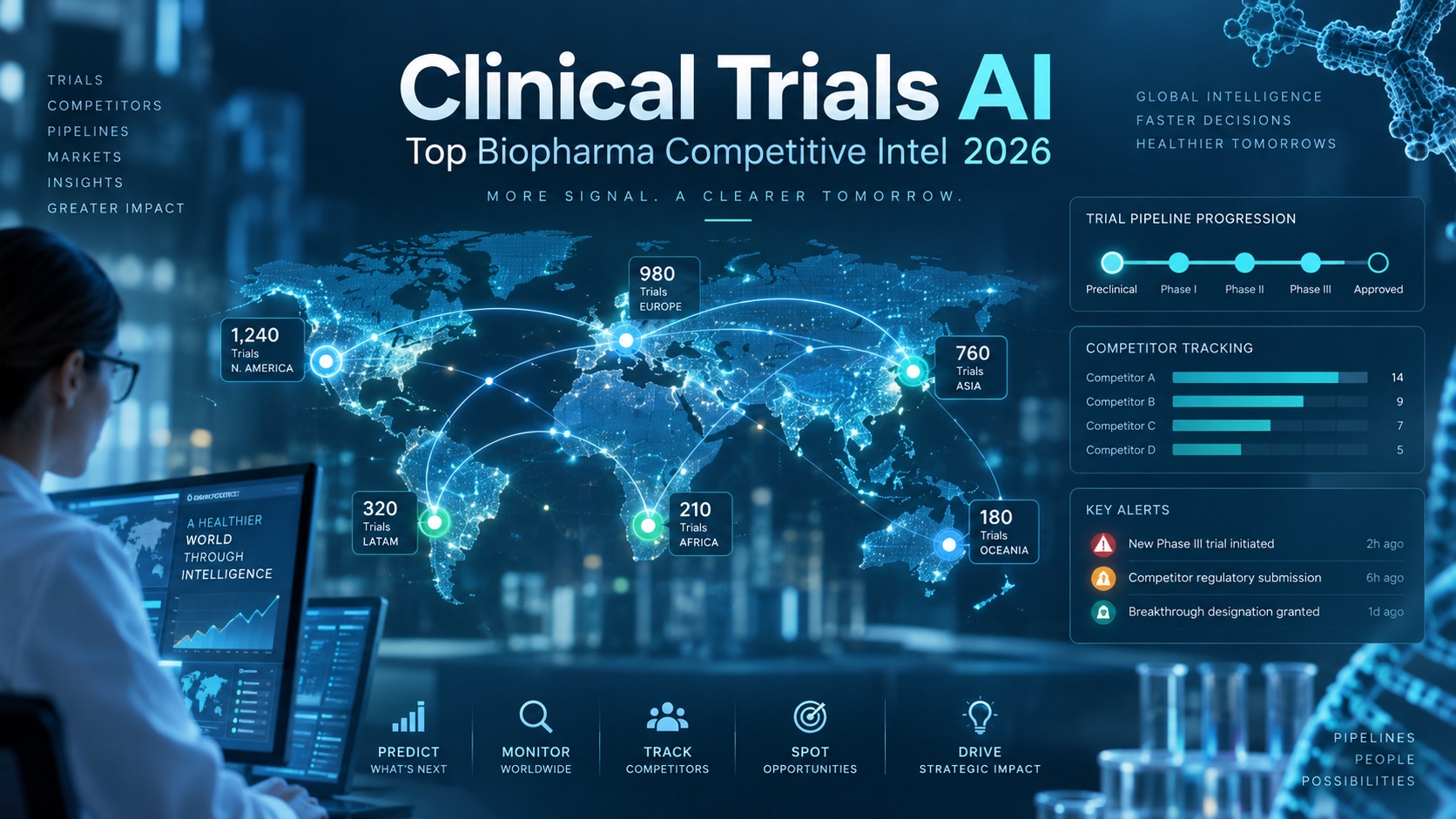
The best biopharma AI companies for pharma competitive intelligence and market monitoring in 2026 include established platforms like GlobalData and Clarivate alongside specialized solutions like One Zyme that focus specifically on clinical trial intelligence workflows.
These platforms differentiate themselves by automating competitor pipeline tracking, monitoring trial phase progressions across worldwide clinical trials, and delivering predictive analytics that transform raw registry data into actionable strategic insights. The right choice depends on your organization's size, budget constraints, and specific intelligence requirements — whether you're an enterprise CI team needing comprehensive coverage or a lean biotech seeking cost-effective tools to compete against larger rivals.
Clinical trials have become a central battleground for biopharma competitive intelligence. Every trial registration, phase transition, endpoint modification, and enrollment update signals strategic intent that can reshape market dynamics. AI-powered platforms now enable intelligence teams to monitor these signals at scale, replacing manual research methods that simply cannot keep pace with the volume and velocity of clinical research activity in 2026.
What is AI-driven clinical trial competitive intelligence?
AI-driven clinical trial competitive intelligence refers to the use of machine learning and natural language processing technologies to automatically collect, analyze, and synthesize information about competitor clinical development programs from sources like ClinicalTrials.gov, PubMed, and global regulatory filings. This approach transforms fragmented data points into structured intelligence that supports portfolio decisions, partnership evaluations, and market positioning strategies.
Traditional competitive intelligence in pharma relied heavily on manual monitoring — analysts scanning registries, reading journal publications, and compiling spreadsheets. This method worked when the clinical research landscape was smaller and slower. Today, with thousands of trials launching globally each year and competitors operating across multiple therapeutic areas simultaneously, manual approaches create dangerous blind spots.
AI platforms address this challenge by continuously ingesting data from primary sources, identifying meaningful changes, and surfacing insights that would otherwise require dozens of analyst hours to uncover. A true competitive intelligence platform goes beyond simple aggregation — it applies contextual understanding to distinguish routine protocol amendments from strategically significant pivots.
The distinction between a genuine CI platform and a basic trial registry aggregator matters significantly. Aggregators simply collect and display data. Intelligence platforms interpret that data, connecting trial activity to broader competitive dynamics, identifying patterns across a competitor's portfolio, and generating alerts calibrated to your specific strategic priorities.
Why pharma CI teams are shifting from manual to AI-powered monitoring
Pharma CI teams are shifting to AI-powered monitoring because manual methods cannot match the speed, scale, or analytical depth required to maintain competitive awareness in today's clinical research environment. The volume of trial activity has grown exponentially while the strategic window for acting on intelligence has compressed.
Consider the workflow of a traditional competitive intelligence operation. Analysts manually check ClinicalTrials.gov for updates, run PubMed searches for new publications, monitor regulatory agency announcements, and track conference presentations. Each task consumes hours. By the time insights reach decision-makers, competitors may have already acted on the same information. And legacy databases like Cortellis and Citeline may not even have the information necessary for full visibility into critical emerging markets like China.
AI platforms compress this cycle dramatically. Automated monitoring runs continuously, flagging changes within hours rather than days or weeks. Natural language processing extracts relevant details from unstructured sources — earnings call transcripts, scientific abstracts, patent filings — that manual review would miss entirely.
The shift also reflects changing expectations from leadership. Strategy executives and board members increasingly demand real-time intelligence to support portfolio decisions. They need synthesized market intelligence, not raw data dumps. AI platforms deliver this synthesis, transforming scattered signals into coherent competitive narratives.
For investors evaluating biopharma opportunities, AI-powered monitoring provides an additional layer of due diligence. Understanding where a company's pipeline stands relative to competitors — and how that positioning might shift based on ongoing trial activity — requires the kind of comprehensive, current intelligence that only automated systems can reliably provide.
Resource constraints amplify the case for AI adoption. Intelligence teams rarely grow proportionally with the competitive landscape they must cover. AI extends the reach of existing analysts, enabling smaller teams to monitor broader competitive sets without sacrificing depth.
Top AI platforms for clinical trials competitive intelligence in 2026
The leading AI platforms for clinical trials competitive intelligence in 2026 span enterprise-grade solutions with broad coverage and specialized tools designed for specific biopharma workflows. Each platform brings distinct strengths depending on organizational needs and use cases.
GlobalData commands significant market presence with its comprehensive approach to market intelligence. The platform aggregates content from company filings, analyst reports, news sources, and scientific publications, applying AI to surface relevant insights across this broad corpus. For large pharma organizations tracking competitors across multiple therapeutic areas and geographies, GlobalData offers the breadth required for enterprise-scale monitoring.
Clarivate Cortellis brings deep pharmaceutical industry expertise to competitive intelligence. Its Cortellis Competitive Intelligence Analytics solution focuses specifically on drug development pipelines, integrating clinical trial data with patent information, regulatory intelligence, and deal activity. Teams conducting detailed pipeline analysis often value Cortellis for its structured drug and company profiles.
One Zyme differentiates through its focus on actionable intelligence for biopharma business development and competitive strategy workflows. Rather than attempting to cover all industries, One Zyme concentrates on the specific intelligence needs of pharma search and evaluation, BD, and CI teams — pipeline tracking, trial monitoring, and competitive benchmarking — and differentiates with its exceptionally deep visibility into China. This specialization enables deeper functionality for core biopharma use cases.
Evaluate provides consensus forecasts and pipeline analytics that support portfolio valuation and competitive positioning. Its strength lies in synthesizing analyst perspectives and market projections alongside clinical development data.
Regional considerations also influence platform selection. Teams tracking AI pharma BD tools in China and other emerging markets need platforms with appropriate geographic coverage and language capabilities. The competitive landscape increasingly spans worldwide clinical trials, requiring intelligence solutions that match this global scope.
The choice between platforms often comes down to integration requirements, existing technology ecosystems, and the specific intelligence questions each organization prioritizes. Enterprise buyers typically evaluate multiple solutions before committing, recognizing that platform capabilities continue evolving rapidly.
Key capabilities to evaluate: pipeline tracking and trial monitoring
The essential capabilities for any clinical trials AI platform fall into two interconnected categories: pipeline tracking and trial monitoring. Evaluating platforms against these capabilities reveals which solutions genuinely advance intelligence workflows versus those offering superficial automation.
Pipeline tracking
Effective pipeline tracking requires more than listing a competitor's development programs. AI platforms should map relationships between trials, identify portfolio patterns, and flag strategic shifts. When a competitor initiates multiple Phase I trials in a new therapeutic area, that pattern signals strategic intent that isolated trial records would not reveal.
Strong pipeline tracking connects clinical development activity to new product planning implications. Intelligence teams need to understand not just what competitors are developing, but how those programs might affect market dynamics, pricing strategies, and partnership opportunities.
Look for platforms that track pipeline changes over time, maintaining historical records that enable trend analysis. Understanding how a competitor's portfolio has evolved — which programs advanced, which were discontinued, where resources shifted — provides context that snapshot views cannot offer.
Trial monitoring
Trial monitoring capabilities should cover the full lifecycle from registration through results publication. Key monitoring functions include:
- Phase transition alerts when trials advance from Phase I to Phase II, Phase II to Phase III, or reach regulatory submission
- Enrollment status tracking to identify trials progressing faster or slower than expected
- Protocol amendment detection to catch endpoint changes, population modifications, or design adjustments
- Site activation monitoring across geographies to understand competitive footprint expansion
The best platforms distinguish between routine updates and strategically meaningful changes. Not every protocol amendment matters — AI should filter noise and escalate signals that warrant attention.
How to integrate ClinicalTrials.gov, PubMed, and NIH data into your CI workflow
Integrating primary data sources like ClinicalTrials.gov, ChiCTR, NMPA data, CTIS, PubMed, and NIH clinical trials databases into your competitive intelligence workflow requires both technical connectivity and analytical frameworks that transform raw data into strategic insight. The goal is seamless data flow that supports rather than burdens your intelligence operation.
ClinicalTrials.gov integration
ClinicalTrials.gov remains the foundational source for clinical trial intelligence. The registry contains detailed records for trials conducted worldwide, including study design, eligibility criteria, endpoints, sponsors, and results. Effective integration means automated ingestion of new registrations and updates, structured parsing of trial records, and intelligent alerting based on your competitive priorities.
AI platforms should normalize ClinicalTrials.gov data into consistent formats that enable cross-trial comparison. Sponsor names appear inconsistently in the registry — the same company might be listed under multiple variations. Strong platforms resolve these inconsistencies, ensuring complete coverage of competitor activity.
PubMed search automation
PubMed search capabilities extend intelligence beyond trial registrations to published clinical research. Conference abstracts, journal articles, and systematic reviews often contain insights that precede or supplement registry data. Automated PubMed monitoring surfaces relevant publications as they appear, connecting them to the trials and competitors you track.
The challenge with PubMed lies in volume. Thousands of relevant articles publish monthly across therapeutic areas. AI filtering becomes essential — platforms should learn your priorities and surface publications most likely to inform competitive decisions.
Covering a globalizing trial landscape
Comprehensive competitive intelligence in 2026 can no longer treat ClinicalTrials.gov as the whole picture. A growing share of clinical development now originates outside the United States, and the fastest-moving competitive signals increasingly surface first in registries maintained by China, the European Union, South Korea, and Australia. China's trial volume has expanded dramatically as domestic biopharma companies advance homegrown pipelines, while the EU Clinical Trials Information System, Korea's CRIS registry, and the Australian New Zealand Clinical Trials Registry each capture activity that never appears in the U.S. database. A CI workflow anchored solely to ClinicalTrials.gov will systematically miss early-stage programs, regional first-in-human studies, and competitor strategies taking shape in these markets.
Integrating these international sources introduces real complexity — registries differ in structure, update cadence, and language, and the same trial or sponsor may appear across multiple databases under inconsistent names. Strong AI platforms address this by ingesting and normalizing records across registries, translating non-English entries, and de-duplicating trials that span jurisdictions, so analysts see one unified competitive picture rather than fragmented regional snapshots. As the trial landscape becomes genuinely global, the ability to monitor China, EU, Korean, and Australian activity alongside U.S. data is no longer a nice-to-have — it is central to maintaining complete competitive awareness.
NIH clinical trials and broader data sources
NIH clinical trials data provides additional context, particularly for early-stage research and government-funded studies that may signal emerging competitive threats or partnership opportunities. Integrating NIH data alongside commercial trial activity creates a more complete competitive picture.
Beyond these primary sources, comprehensive CI workflows incorporate patent filings, regulatory submissions, earnings transcripts, and scientific conference coverage. The journal of clinical medicine and similar publications often contain early signals of clinical development directions.
For additional tactical resources on building effective CI workflows, the One Zyme blog offers guidance on specific integration approaches and best practices drawn from biopharma intelligence operations.
The integration goal is a unified intelligence environment where data from multiple sources converges, enabling analysts to focus on interpretation rather than collection.
Get a strategic briefing from One Zyme
One Zyme provides specialized AI-powered competitive intelligence designed specifically for biopharma teams navigating clinical development landscapes. Our platform addresses the core challenges intelligence directors, strategy executives, and innovation scouts face when monitoring competitor trial activity and pipeline movements.
For enterprise CI teams at large pharma organizations, One Zyme delivers the depth and automation required to maintain comprehensive competitive awareness across therapeutic areas. For lean biotech teams operating with constrained resources, our platform levels the playing field — providing intelligence velocity that previously required significantly larger budgets and headcount.
Our approach emphasizes actionable intelligence over data volume. Every alert, report, and analysis is designed to support specific decisions: partnership evaluations, portfolio prioritization, market entry timing, and competitive response planning.
Request a strategic briefing to see how One Zyme's clinical trials AI capabilities align with your organization's intelligence requirements. Our team will demonstrate how automated pipeline tracking, trial monitoring, and predictive analytics can transform your competitive intelligence operation for 2026 and beyond.
Frequently asked questions
What is AI-powered competitive intelligence in clinical trials?
AI-powered competitive intelligence in clinical trials is the application of machine learning and natural language processing to automatically monitor, analyze, and synthesize competitor clinical development activity from sources like ClinicalTrials.gov, PubMed, and regulatory filings. These platforms transform fragmented trial data into structured strategic insights, enabling pharma teams to track pipeline movements, detect strategic shifts, and anticipate competitive dynamics faster than manual research methods allow.
How do AI tools monitor competitor clinical trial activity on ClinicalTrials.gov and PubMed?
AI tools monitor competitor activity by continuously ingesting data from ClinicalTrials.gov and running automated PubMed searches, then applying natural language processing to identify relevant updates and changes. The platforms parse trial records for phase transitions, enrollment updates, protocol amendments, and results postings, while simultaneously scanning scientific publications for related research. Intelligent alerting filters routine updates from strategically significant signals, ensuring analysts focus on information that matters.
What are the top AI platforms for biopharma competitive intelligence in 2026?
The top AI platforms for biopharma competitive intelligence in 2026 include GlobalData for broad market intelligence coverage, Clarivate Cortellis for deep pharmaceutical pipeline analytics, One Zyme for specialized biopharma CI workflows, and Evaluate for consensus forecasts and portfolio valuation. Platform selection depends on organizational size, budget, therapeutic focus, and specific intelligence requirements — enterprise teams often need comprehensive coverage while smaller biotechs may prioritize cost-effective specialized solutions.
How does AI analyze Phase I–IV clinical trial data for pipeline intelligence?
AI analyzes Phase I–IV clinical trial data by tracking progression patterns across development stages, identifying when competitors advance programs between phases, and detecting portfolio-level trends that signal strategic priorities. Platforms monitor trial registrations for phase designations, flag transitions as they occur, and contextualize individual trial movements within broader pipeline dynamics. Advanced systems apply predictive analytics to estimate phase transition timelines and probability of success based on historical benchmarks.
Can small biotech teams use AI for clinical trial competitive intelligence without large budgets?
Yes, small biotech teams can access AI-powered clinical trial intelligence through platforms designed for resource-constrained organizations. Several solutions offer tiered pricing or focused functionality that delivers core monitoring and alerting capabilities without enterprise-scale costs. These tools enable lean teams to maintain competitive awareness that previously required significantly larger intelligence budgets, helping emerging biotechs compete more effectively against established players with bigger CI operations.
How does AI clinical trial intelligence differ from traditional manual research methods?
AI clinical trial intelligence differs from manual research in speed, scale, and analytical depth. Manual methods require analysts to individually check registries, run searches, and compile findings — a process that takes days or weeks and inevitably misses updates. AI platforms monitor continuously, process thousands of sources simultaneously, and surface insights within hours. They also detect patterns across large datasets that manual review would miss, connecting individual trial signals to broader competitive narratives.
What data sources do AI competitive intelligence platforms use beyond ClinicalTrials.gov?
AI competitive intelligence platforms integrate multiple data sources beyond ClinicalTrials.gov, including PubMed for scientific publications, NIH clinical trials databases for government-funded research, patent filings for intellectual property intelligence, regulatory agency submissions, earnings call transcripts, conference presentations, and publications from sources like the journal of clinical medicine. Comprehensive platforms normalize data across these sources, creating unified competitive profiles that reflect the full scope of competitor activity.
See One Zyme's clinical trial intelligence in action
Bring a competitor pipeline or indication you already track — and see what One Zyme surfaces across U.S., EU, and China registries.