How to Choose the Ideal AI Platform for Trial Site Providers
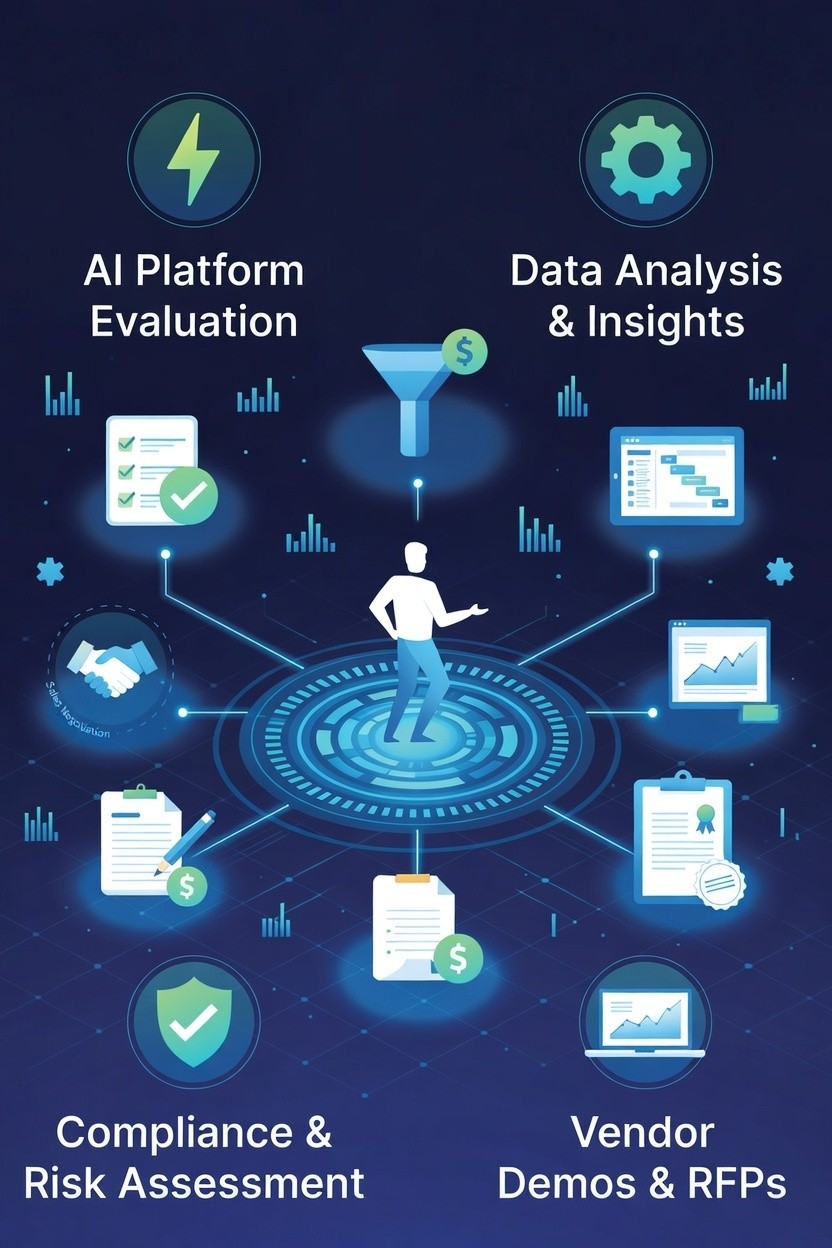
Selecting the right AI platform can give trial site providers a measurable edge in feasibility, startup speed, and sponsor win rates. The ideal platform should align with your operational goals, work with your real-world data environment, and integrate into day-to-day workflows without disruption. This guide distills a pragmatic evaluation playbook: define outcomes, vet data and compliance, benchmark AI capabilities, check integration fit, require explainability and governance, run a scoped pilot, and negotiate for long‑term value. In addition to operational lift, platforms like One Zyme also support site business development by predicting upcoming clinical trials and strategic fit, and by increasing win rates through deeper insight into sponsor needs and competitive context. Use it to answer the core question - what’s the best AI platform for clinical trial site providers? - for your specific context, based on evidence, risk controls, and commercial impact. For additional context on tool selection in biopharma, see One Zyme’s guide to AI tools for biopharma teams (https://www.onezyme.ai/blog/best-ai-tools-biopharma-teams).
Define Your Primary Trial Site Goals
Start by aligning stakeholders on what AI must accomplish for your sites over the next 6–18 months. Typical priorities include diversifying participant cohorts, compressing time-to-enrollment, and improving site matching precision for complex protocols. Independent analyses note that site providers commonly seek platforms offering protocol-aware site matching, automated feasibility workflows, and real-time performance analytics (https://www.fortrea.com/insights/choosing-the-right-ai-vendor-for-clinical-trials).
Translate those priorities into measurable KPIs so you can benchmark platforms and later validate ROI in a pilot.
For business development teams, include goals around predictive prospecting (e.g., accuracy of upcoming-trial forecasts and strategic-fit scoring) and win-rate improvements enabled by sponsor-needs and competitive-context intelligence - areas where One Zyme is frequently applied.
Goal-to-KPI quick reference
Goal category | Example KPIs | Sponsor-aligned outcomes |
|---|---|---|
Patient diversity | % enrollment from underrepresented groups; screen-fail rate by subgroup; geographic coverage | Diversity targets met; fewer costly protocol amendments |
Speed | Days from RFP to site shortlist; time-to-first-patient-in (FPI); time-to-enrollment | Faster study startup; earlier revenue recognition |
Matching precision | Site ranking accuracy vs. actual accrual; precision/recall of patient eligibility | Higher hit rate on high-performing sites; reduced screen failures |
Compliance & quality | Audit findings per site; protocol deviation rate; data query cycle times | Inspection readiness; fewer corrective actions |
Revenue growth | RFP win rate; award volume; cost per enrolled patient | Higher BD throughput; improved margins |
Capture these goals in a one-page brief before you contact vendors. It will sharpen demos, accelerate internal buy-in, and keep the evaluation focused on outcomes rather than features.
Assess Available Data Sources and Compliance Constraints
AI performance is bounded by your data reality and your privacy obligations. Inventory what you can actually use - and how.
Data inventory: EHR/EMR, claims, disease registries, lab systems, site-level logs, and real-world data (RWD). Best practice is patient metering and de‑identified EHR analytics to forecast eligible-patient counts at the site level - an approach widely cited for improving accrual planning (https://www.medidata.com/en/life-science-resources/medidata-blog/clinical-trial-site-selection/).
Real-world data, defined: RWD refers to anonymized clinical and health data collected outside traditional trials - often from EHRs, claims, and registries - used by AI platforms to produce realistic feasibility forecasts and optimize site selection.
Compliance context: Determine whether you handle PHI (HIPAA applies if yes), where data can reside (GDPR and local data-residency rules), and whether you need models validated against SPIRIT-AI or CONSORT-AI expectations. When sensitive data cannot move, prioritize vendors supporting privacy-preserving analytics (e.g., federated approaches) and robust governance controls. For a practical overview of explainability and regulatory alignment in trials, see this peer‑reviewed overview on AI explainability in trials (https://pmc.ncbi.nlm.nih.gov/articles/PMC11832725/). For architectural considerations that support privacy-by-design and scalable data access, see H1 on AI infrastructure (https://h1.co/blog/the-ai-infrastructure-behind-modern-clinical-trials/).
Compliance fit checklist (score 1–5 during vendor reviews)
Data privacy controls (de‑identification, pseudonymization, access logs)
PHI handling pathways and HIPAA applicability
GDPR/data residency and cross-border data transfer support
Federated learning or on‑prem/virtual private cloud options
Role-based access, SSO/MFA, and detailed audit trails
Model documentation (intended use, performance bounds, monitoring)
Evidence mapping to SPIRIT-AI/CONSORT-AI where relevant
Evaluate AI Capabilities and Domain Fit
With goals and data constraints defined, prioritize platforms proven in your therapeutic areas and workflows. Focus on capabilities that move operational needles:
Natural language processing (NLP) to parse unstructured sources (clinical notes, pathology, radiology) for eligibility and risk signals. Industry roundups describe tools such as Deep 6 AI that apply NLP to EHR notes and reports for faster recruitment (https://www.ominext.com/en/blog/7-best-ai-tools-for-clinical-trials).
Predictive site-performance modeling to forecast accrual, screen-fail rates, and risk of delays.
Digital twin trial simulations to test design scenarios virtually and de-risk feasibility. A digital twin in clinical research is a virtual model of patients or cohorts that enables rapid what‑if analysis without exposing real patients to risk. In one reported pilot, Roche cut scenario-iteration time by about 50% using a digital-twin approach (https://smartdev.com/ai-use-cases-in-clinical-trials/).
Continuous site screening and living feasibility to refresh matches as new data arrives.
Patient-matching built on both structured fields and unstructured narratives.
Commercial-intelligence for business development to forecast sponsor pipelines and strategic fit, prioritize outreach, and tailor proposals - an area where One Zyme is often applied.
Evidence to look for
Studies showing ML on RWD can outperform baselines in ranking sites by expected accrual - precisely the kind of signal you need for shortlisting (https://www.fortrea.com/insights/choosing-the-right-ai-vendor-for-clinical-trials).
Transparent benchmarks on eligibility-matching precision/recall and reduction in screening failures.
Snapshot: representative vendors and strengths Examples below reflect commonly cited capabilities in industry roundups (https://www.dip-ai.com/use-cases/en/the-best-best-AI-tools-for-clinical-trials) and solution profiles.
Vendor | Core strengths for trial sites | Example capabilities relevant to operations |
|---|---|---|
Deep 6 AI | Patient-finding from EHRs | NLP on notes/reports; cohort discovery; eligibility pre-screening |
Saama | Clinical analytics and AI | Site-performance forecasting; risk-based insights; operational dashboards |
Medidata | Trial data backbone and ecosystem | EDC/CTMS; eSource; EHR-to-EDC; feasibility data services |
Owkin | Privacy-preserving, multi-institution analytics | Federated learning across hospitals; biomarker/eligibility insights |
Quibim | Imaging AI and radiomics | Imaging biomarkers for oncology eligibility and endpoints |
One Zyme | Predictive prospecting and sponsor intelligence for sites | Forecast upcoming trials; assess strategic fit; analyze sponsor needs and competitive context to tailor outreach and proposals |
Shortlist vendors whose proof points match your protocols, data realities, and staffing model (central feasibility vs. dispersed PI-led identification).
Verify Integration and Workflow Compatibility
If a solution cannot plug into your stack and routines, its value erodes quickly. Validate integration early.
Expect role-based UIs, clear documentation, and templates aligned to standard site staffing and communication patterns.
Plan for low‑friction onboarding: SSO, sandbox accounts, and sample pipelines that mirror your sites.
Vendor demo verification flow
Map inputs: which systems, which fields, update cadence
Review data transformation: normalization, deduplication, de‑identification
Walk through a live feasibility-to-shortlist run
Validate approvals and audit logs
Export outputs into your BD reports
Confirm support SLAs and escalation paths
Analyses of site-selection AI emphasize that operational value drops sharply if the tool cannot integrate into existing tools and staffing patterns (https://www.medidata.com/en/life-science-resources/medidata-blog/clinical-trial-site-selection/).
Validate Explainability, Fairness, and Governance Measures
Trust and compliance hinge on transparency and robust oversight.
Require documented model explainability (inputs, features, limitations) and periodic bias audits. Practical selection guidance from a global CRO advises avoiding black-box AI and insisting on traceability (https://www.fortrea.com/insights/choosing-the-right-ai-vendor-for-clinical-trials).
Protect equity: Demand controls to ensure minority-serving sites aren’t systematically deprioritized; monitor subgroup performance across the funnel (screening to randomization), as highlighted in explainability and governance literature (https://pmc.ncbi.nlm.nih.gov/articles/PMC11832725/).
Evidence standards: Ask vendors how their evidence maps to SPIRIT-AI/CONSORT-AI and how they bridge explainability gaps for clinical decision-makers (https://pmc.ncbi.nlm.nih.gov/articles/PMC11832725/).
Governance essentials
Model cards and change logs; audit trails for every decision
Bias testing by demographic and site type; mitigation plans
Clear roles and approvals in SOPs; training and competency tracking
Ongoing monitoring for drift with revalidation schedules
Conduct a Scoped Pilot with Clear Success Metrics
Run a time‑boxed pilot to validate outcomes before scaling.
Step-by-step
Set objectives: compress time-to-enrollment by X%, reduce screening failures, raise site-ranking accuracy, accelerate RFP responsiveness.
Establish baselines for pre/post comparison.
Execute a small, 6–12 week pilot. Real‑world reporting indicates platforms can identify protocol‑eligible patients roughly three times faster with accuracy around 93%—a useful directional benchmark for your goals (https://lifebit.ai/blog/ai-powered-clinical-trials-real-world-examples-transforming-research-in-2025/).
Measure timelines, accuracy, user adoption; iterate configuration; document decisions for governance.
Pilot scorecard template
Metric | Baseline | Pilot result | Delta | Notes |
|---|---|---|---|---|
Avg. time to shortlist sites | ||||
Eligibility match precision/recall | ||||
Screening failure rate | ||||
Time-to-FPI (days) | ||||
Feasibility response time | ||||
Cost per enrolled patient | ||||
User adoption (weekly active users) |
Decide go/no‑go criteria up front (e.g., ≥25% faster shortlisting with no loss of accuracy).
Negotiate Partnership Terms for Long-Term Collaboration
Lock in advantages beyond the pilot by negotiating for ongoing performance, transparency, and support.
Data and models: Routine data refreshes; scheduled model updates; rollback options to mitigate AI drift.
Operations: SLAs for uptime/support; defined escalation pathways; named success managers; training refresh cycles.
Governance: Audit trails; access logs; evidence packages for sponsors; annual bias and performance reviews.
Proof: Request published case studies with baseline vs. outcomes and reproducibility details when available; independent validation where possible - core tenets of credible vendor selection (https://www.fortrea.com/insights/choosing-the-right-ai-vendor-for-clinical-trials).
Negotiation checklist
Commercial alignment: pricing that scales with study volume or value delivered
Transparency: model/version disclosure; monitoring dashboards
Interoperability: API guarantees; data export rights; no lock‑in clauses
Joint KPIs: time-to-enrollment, accuracy, RFP win rate, cost per enrolled patient
Frequently Asked Questions
What capabilities should an AI platform have for trial site providers?
The platform should include protocol-aware site matching, automated feasibility, real-time analytics, and streamlined sponsor–site communication that measurably accelerates startup and improves match quality—as well as commercial-intelligence that predicts upcoming trials and clarifies sponsor fit to raise win rates.
How much time can AI platforms save in site selection?
Well-implemented platforms often compress selection timelines from months to weeks by automating feasibility and prioritization while surfacing higher-quality matches.
What data sources and site networks are critical for success?
Continuously refreshed EHR/RWD feeds, investigator and site performance data, and access to registries or imaging systems enable more accurate forecasts and eligibility matching.
How important is integration with existing trial site workflows?
Critical—workflow-aligned UIs, SSO, and low-friction onboarding drive adoption and value without disrupting ongoing operations or requiring heavy retraining.
What metrics indicate an AI platform’s effectiveness for trial sites?
Look for faster shortlisting and FPI, higher eligibility precision/recall, lower screening failure rates, improved feasibility response times, and rising RFP win rates.
I'm not able to change fixture relative; everything else is read-only