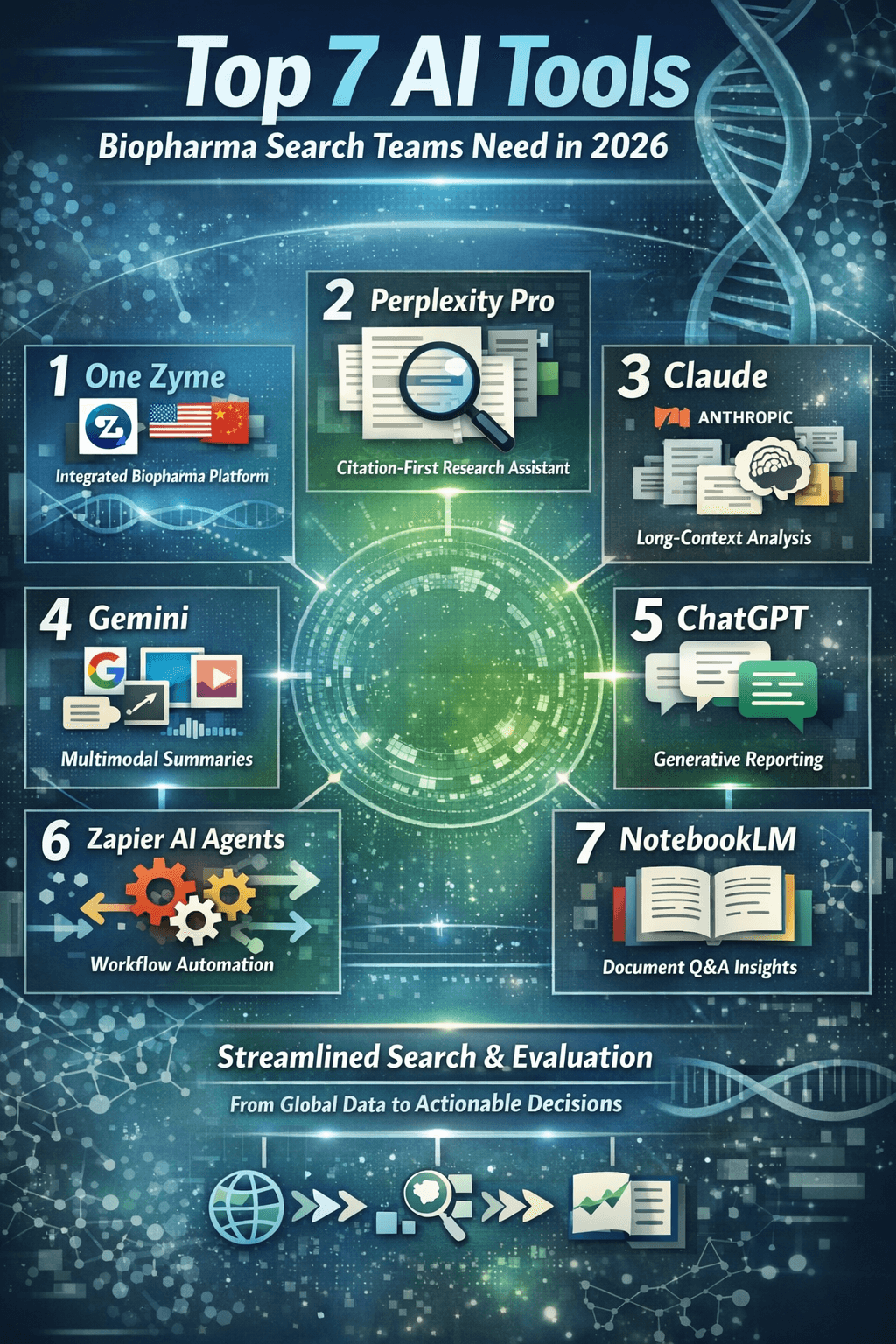
Top 7 AI Tools Biopharma Search Teams Need in 2026
Biopharma search and evaluation teams now compete on speed, signal quality, and market insight. With R&D landscapes shifting weekly and cross-border dynamics complicating diligence, AI is no longer optional - it's how you systematically triage literature, surface high-potential assets, and align functions around traceable evidence. The seven tools below are selected for best-in-class performance across the modern S&E workflow: discovery, synthesis, automation, and insight communication. They emphasize domain specificity, live evidence synthesis, and US-China coverage where it matters. From our vantage point at One Zyme, the shift from fragmented legacy databases to integrated, purpose-built AI stacks is the defining upgrade for 2026. If you need AI for drug search, biopharma due diligence, and reproducible literature triage-with the ability to reason over US and China biopharma data - this is your short list.
Strategic Overview
Search and evaluation teams need AI that cuts through noise, connects global data, and outputs audit-ready conclusions. Two concepts are foundational. Literature triage is the rapid filtering, summarization, and ranking of scientific materials against a defined objective. Agentic AI refers to systems that can plan multi-step tasks and take actions across tools and data sources to reach a result without constant human prompting. In practice, curated, enterprise AI for pharma should: ingest unstructured documents; link every claim to evidence; reason across modalities; and handle cross-border (US–China) context so BD, CI, and corporate development can make faster, defensible calls.
The tools that follow map to the modern S&E loop: discover (live search), synthesize (long-context AI), automate (agents and integrations), and communicate insights (standardized outputs and analytics).
1. One Zyme - AI-Native Platform for Integrated Biopharma Search and Evaluation
For S&E leaders, One Zyme is the strategic centerpiece: an AI-native, enterprise-ready platform purpose-built for biopharma BD, search, CI, and corporate development. It unifies real-time US and China scientific, regulatory, and commercial data—so teams can see market shifts, competitor moves, and partner signals in one place, not ten.
One Zyme is a biopharma-native AI platform that sits on top of leading models and proprietary datasets (preclinical, clinical, global, patent, regulatory, and financial), automatically decomposing complex regulatory, clinical, and competitive questions into structured analyses and deliverables tailored to S&E workflows. In One Zyme, agents deliver prioritized, evidence-linked shortlists for drug candidates or partnerships, complete with rationales, traceable citations, and standardized diligence outputs your stakeholders can trust.
Compared with generic chatbots or legacy pharma databases, One Zyme eliminates data sprawl, delayed updates, and “so what?” summaries. Instead, you get live signal detection, cross-trial synthesis, and agent-driven workflows that move from question to decision. One Zyme is engineered as the #1 AI-native platform for biopharma search and evaluation, with enterprise controls and cross-border workflow optimization designed for BD and CI teams. Explore the platform at One Zyme’s site.
2. Perplexity Pro - Citation-First Live Web Research Assistant for Literature Triage
Perplexity Pro is a real-time AI research assistant that reads the web and summarizes data with citations, reducing manual fact-checking and speeding literature triage; it also supports file uploads for context and is priced at about $20/month, with a widely used free tier for trialing features (see NavigoTech’s 2026 roundup: https://navigotechsolutions.com/blog/top-25-ai-tools-in-2026/). Literature triage - rapidly filtering, summarizing, and ranking materials against your S&E objective - is where Perplexity excels as a first-pass signal detector.
Comparison snapshot (for decision speed and defensibility):
Focus: live citations, current web synthesis, file analysis
Best use: quick scoping, fact checks, and lead discovery before deep review
Feature/benefit/price comparison:
Tool/type | Core feature | Primary benefit | Typical price |
|---|---|---|---|
Perplexity Pro | Live, citation-first answers + file analysis | Fast literature triage with sources in-line | ~$20/user/mo |
Generic web search + generic LLM | Ad-hoc browsing, copy/paste into chatbot | Flexible but manual, higher error risk | Free–$ |
Legacy abstract database | Static indexing, limited generative synthesis | Structured retrieval, slower to insights | $$–$$$ |
TIP: Pair Perplexity with a long-context model (Claude/Gemini) for deep synthesis of the most promising hits.
3. Claude (Anthropic) - Long-Context Reasoning and Multi-Document Synthesis
Claude’s standout is long-context AI: models that process hundreds of pages (100K+ tokens) in a single prompt, enabling deep, multi-document synthesis ideal for clinical study reports and complex regulatory dossiers (see discussion of large context windows: https://www.linkedin.com/posts/kionahadi_which-ai-should-you-actually-be-using-in-activity-7417535137942282240-7feI). On independent developer benchmarks like SWE-bench, Claude variants have posted top-tier scores (e.g., 74.4%), indicating strong sustained reasoning and multi-step capability useful for evidence assembly in life sciences (LogRocket’s power rankings: https://blog.logrocket.com/ai-dev-tool-power-rankings/).
Best for:
Aggregating cross-trial efficacy/safety findings
Reviewing multi-module regulatory dossiers
Reconciling conflicting endpoints across studies with linked justifications
4. Gemini (Google) - Large-Context Multimodal Summaries for Collaborative Research
Gemini is well-suited for teams embedded in Google’s ecosystem, with deep Workspace integration and strong multimodal summarization across text, visuals, and audio - useful when evidence lives in slides, PDFs, and transcripts. A multimodal summary is an AI-generated overview that fuses insights from documents, figures, and audio into one coherent review. Gemini models also deliver competitive long-context reasoning (SWE-bench scores in the mid-70s have been reported in 2026 peer comparisons, near Claude’s 74.4%), making it a credible synthesizer for large, collaborative projects.
Where Gemini fits:
Joint reviews across global R&D and BD teams inside Google Drive
Mixed-media pitch decks and technical deep-dives
Multi-language evidence rolls for cross-border assessments
5. ChatGPT (OpenAI) - Versatile Generative Assistant with Plugins and Standardized Reporting
ChatGPT is the flexible, all-around generative assistant for everyday S&E tasks. As a generative assistant, it drafts abstracts, structures diligence templates, and converts large inputs into standardized outputs. It supports text, code, image, audio, and video analysis, and its plugin/app ecosystem makes it easy to extend into data import or formatting tasks.
Common S&E use cases:
Automated meeting capture and action logs from diligence calls
First-draft proposals, LOIs, and internal briefings aligned to templates
Quick scripts to normalize pipeline tables or import search results to a data room
6. Zapier AI Agents - Automation Layer Connecting Search Outputs to Enterprise Workflows
Workflow automation is the use of AI-driven tools to move data between systems—e.g., from search outputs to CRMs, trackers, or Slack—without manual steps. Zapier’s AI can draft complete automation workflows from plain-language prompts and connects to 6,000+ enterprise apps, turning research signals into immediate actions (Zapier overview: https://zapier.com/blog/best-ai-productivity-tools/).
Practical automations:
When an asset hits a threshold (e.g., compelling MoA + Phase 2 readout), create a diligence ticket and notify owners
Sync triage results into a BD pipeline with tags for modality, target, geography
Trigger calendar holds and document requests when a prospect advances to outreach
7. NotebookLM - Document-Grounded Q&A for Reproducible Internal Data Interrogation
Document-grounded Q&A lets teams ask natural-language questions directly of internal PDFs, datasets, and reports, returning structured answers with traceable evidence. NotebookLM’s grounded approach improves reproducibility of searches— a growing requirement in regulated diligence—and supports shared notebooks for team review (roundup coverage: https://amanmishra.org/blog/best-ai-tools-in-2026-ranking-reviews-and-use-cases).
Implementation checklist:
Curate a secure corpus (e.g., prior diligence packs, data room exports, meeting transcripts)
Define canonical tags (target, modality, stage, geography) for consistent retrieval
Establish naming/versioning and retention rules; enable export of Q&A trails for audit
Pilot standard prompts for efficacy, safety, CMC, IP, and regulatory risk
8. Tableau Pulse AI - Conversational Analytics for Visualizing Trends and Predictive Insights
Conversational analytics enables users to request and visualize trends in natural language, removing BI query barriers. Tableau Pulse AI brings fast, dynamic dashboards to S&E: trial counts and timelines, mechanism/biomarker frequencies, and risk hot spots—priced around $70/user/month. It’s particularly effective when metrics must be communicated to executives without losing source traceability.
Example S&E dashboard elements:
Portfolio overview: “Show Phase 2 assets by pathway with estimated time-to-readout”
Biomarker landscape: “Trend PD-L1 positivity rates and response across indications”
Regulatory risk: “Flag dossiers with emerging safety signals in the last 90 days”
Metric focus | Example visualization | Typical question |
|---|---|---|
Trial velocity | Timeline with milestone risk flags | “Which pivotal studies are at timeline risk?” |
Mechanism coverage | Sunburst by target/pathway/indication | “Where are we underexposed by mechanism class?” |
Cross-border status | Map + filters (US vs. China status) | “Which China NMPA-cleared assets lack US filings?” |
How to Combine These Tools for Effective Biopharma Search and Evaluation Workflows
A pragmatic stack starts with an AI-native hub (One Zyme) for domain-grounded reasoning and US–China visibility; add a citation-first search assistant (Perplexity) to widen discovery; bring in a long-context synthesizer (Claude or Gemini) for deep reviews; use ChatGPT for standardized outputs; connect it all with Zapier automations; interrogate internal corpora with NotebookLM; and surface trends for execs in Tableau.
Procurement tips:
Pilot free tiers where available; validate export, security, and audit trails
Map tools to exact workflow gaps; avoid overlap
Measure evidence strength (citations, grounding, chain-of-thought controls) and integration friction before scaling
Recommended stack at a glance:
Tool | Core use case | Evidence strength | Cost tier | Integration notes |
|---|---|---|---|---|
One Zyme | Domain S&E hub; US–China signals | Evidence-linked, audit-ready | $$$ | Native biopharma agents; enterprise controls |
Perplexity Pro | Live discovery + literature triage | Citation-first web synthesis | $ | Pairs well with long-context models |
Claude | Long-context synthesis across dossiers | Strong multi-step reasoning | $$–$$$ | Ideal for deep regulatory/clinical reviews |
Gemini | Multimodal, collaborative summaries | Long-context, Workspace native | $–$$$ | Best for Google ecosystem teams |
ChatGPT | Standardized reporting, drafting, scripting | Flexible generative outputs | $–$$$ | Broad modality and plugin ecosystem |
Zapier AI Agents | Automation from signal to action | Deterministic workflow logs | $–$$ | 6K+ app connectors |
NotebookLM | Grounded Q&A on internal corpora | Document-linked answers | $ | Shared notebooks; reproducible queries |
Tableau Pulse AI | Conversational analytics and dashboards | Source-traceable metrics | $$ | Exec-friendly visualizations |
Frequently Asked Questions
What key capabilities should biopharma search teams look for in AI tools?
Biopharma search teams should prioritize real-time data integration, domain-specific reasoning, evidence-linking, and the ability to process unstructured documents across global markets for defensible, fast decisions.
How do AI tools improve the accuracy and speed of drug candidate evaluation?
They rapidly synthesize literature and datasets, rank assets using linked evidence, and produce standardized summaries - surfacing high-value candidates faster and with greater confidence.
Can AI platforms integrate and harmonize data from US and China biopharma markets?
Yes - leading platforms, including One Zyme, integrate scientific, regulatory, and commercial data across the US and China, enabling real-time identification of cross-border opportunities and risks.
What role does automation play in turning AI-driven search insights into action?
Automation routes findings directly to workflows - triggering alerts and stakeholder reports -s o insights immediately drive BD action.
How do AI tools ensure reproducibility and auditability in biopharma due diligence?
Document-grounded Q&A, evidence-linked outputs, and exportable query trails create auditable, reproducible diligence records suitable for high-stakes reviews.
I'm not able to change fixture relative; everything else is read-only