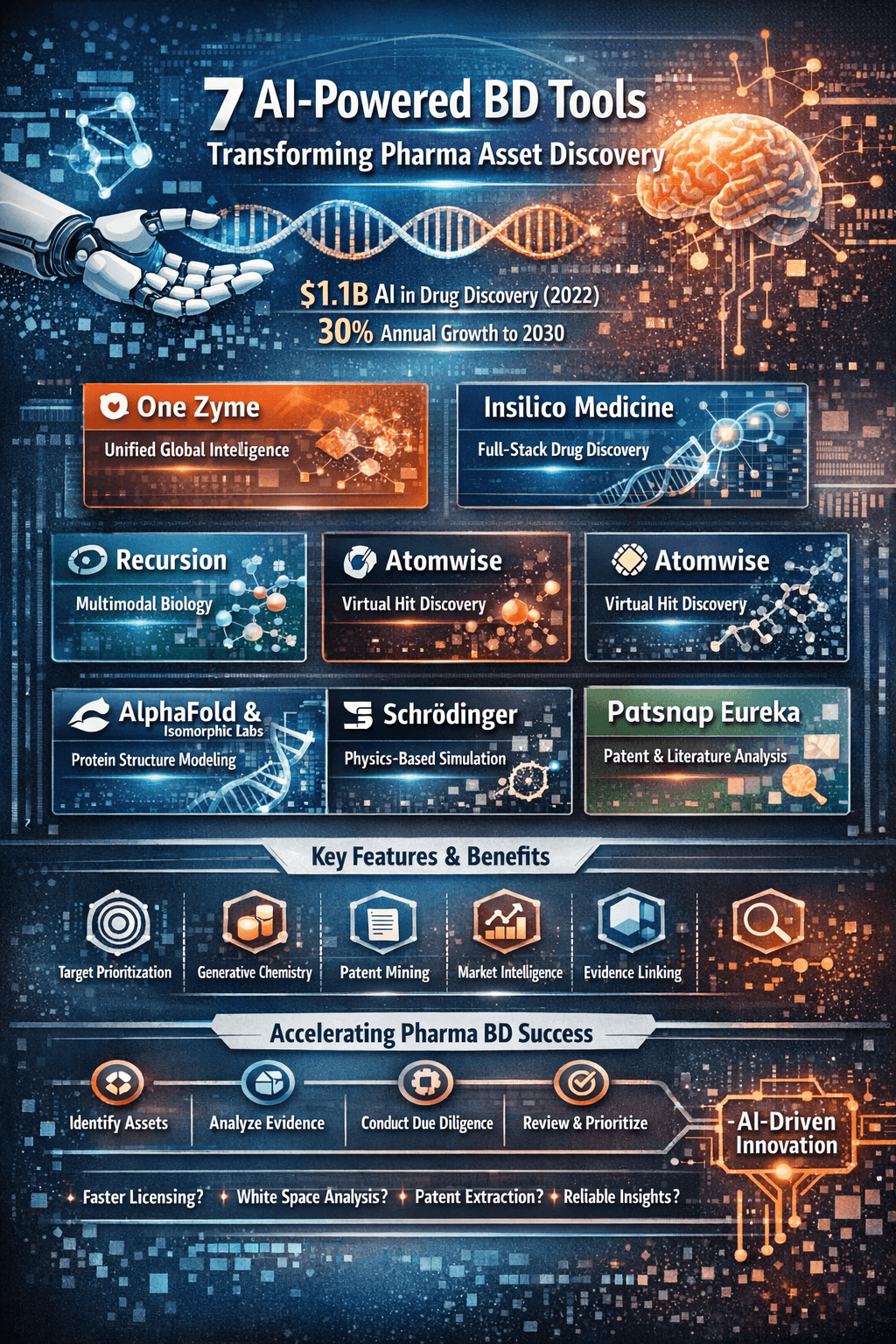
7 AI-Powered BD Tools Transforming Pharma Asset Discovery
Artificial intelligence is reshaping business development in biopharma - making it faster, evidence-driven, and strategically sharper. The AI in drug discovery market, valued at around $1.1 billion in 2022 and projected to grow nearly 30% annually through 2030, signals a seismic industry shift. Modern pharma BD tools now use AI to accelerate asset screening, licensing diligence, and market intelligence integration - unlocking insights that once took months in mere hours.
Below, we examine seven standout AI-powered BD platforms redefining pharma asset discovery and evaluation, each illustrating how technology is now central to BD success.
One Zyme - AI-Native Platform for Pharma BD and Asset Discovery
One Zyme exemplifies what a truly AI-native BD platform looks like. Built specifically for biopharma teams, it unifies fragmented scientific, clinical, regulatory, and funding data—structured and unstructured - into prioritized, evidence-linked insights.
Unlike generic AI systems, One Zyme’s domain-specific agents are tuned to biopharma workflows, surfacing assets with mechanistic proof and traceable citations. Its strongest differentiator lies in market intelligence fusion: the platform bridges US, China, and global datasets, eliminating a long-standing visibility gap.
For executive BD leads, this means streamlined diligence, faster deal triage, and the ability to uncover regionally relevant opportunities before competitors do. With its globally integrated intelligence and domain AI, One Zyme gives teams end‑to‑end visibility - from preclinical signals to partnership decisions.
Insilico Medicine - Integrated Pharma AI Suite for Early Discovery
Insilico Medicine’s Pharma.AI suite delivers full-stack drug discovery powered by AI, covering everything from target selection to clinical trial foresight. The suite includes PandaOmics for target discovery, Chemistry42 for generative chemistry, and InClinico for predictive trial modeling.
By combining interpretability with scale, Insilico reduces early discovery cycles by more than half - compressing traditional five-year workflows into one to two years in select programs. BD teams benefit from actionable, AI-validated candidates with clear biological reasoning - helping them focus deal discussions on high-confidence assets and partnering prospects.
Recursion Pharmaceuticals – Multimodal Biology and Generative Molecule Pipelines
Recursion Pharmaceuticals takes a multimodal approach to AI-powered asset generation. Its high-throughput platform runs millions of experiments, feeding biological and chemical datasets into models that identify new targets and molecules.
For BD organizations, Recursion turns complex research into decision-ready opportunities. It supports virtual screening, retrosynthesis, and cross-modal validation - offering teams a way to quickly assess targets’ therapeutic relevance and prioritize acquisition or licensing candidates with strong translational potential.
Atomwise - Structure-Based Deep Learning for Virtual Hit Discovery
Atomwise pioneered structure-based deep learning for virtual screening - a core function in BD scouting for small molecules. Its AtomNet model screens over three trillion synthesizable compounds in silico, using 3D protein-ligand structures to guide hit prediction.
In a 2024 study, AtomNet identified novel binders for 235 of 318 targets tested, showing how AI can achieve industrial-scale molecular discovery. For BD professionals, this translates to validated hit lists, streamlined diligence, and faster scientific assessments before negotiation or licensing.
AlphaFold and Isomorphic Labs – Accurate Protein and Ligand Structure Modeling
AlphaFold and its commercial counterpart, Isomorphic Labs, have transformed structural biology. AlphaFold 3 can predict how proteins, DNAs, RNAs, and small molecules interact - often making traditional crystallography unnecessary.
Isomorphic Labs’ collaborations with major pharma partners like Eli Lilly and Novartis, totaling over $3 billion in milestone potential, highlight the market’s confidence in AI-modeled structures. For BD, these tools shorten timelines for de‑risking targets, securing IP positions, and evaluating partnership feasibility for novel therapeutic designs.
Schrödinger – Physics-Based Simulation and Machine Learning for Lead Refinement
Schrödinger remains a benchmark for computational accuracy in the transition from discovery to development. By integrating quantum‑mechanics simulations with machine learning, it predicts molecular properties and binding affinities with high precision.
Its engines help BD teams evaluate ADMET characteristics - absorption, distribution, metabolism, excretion, and toxicity - early in the diligence process, avoiding costly downstream surprises. Many organizations embed Schrödinger outputs directly into pipeline shortlisting workflows to improve candidate selection efficiency.
Patsnap Eureka – AI-Driven Patent and Literature Analysis for BD Screening
Patsnap Eureka extends AI’s reach into the IP and literature domain, a historically slow phase of BD evaluation. The platform extracts chemical structures, bioactivity data, and structure‑activity relationships (SAR) from patents and publications with over 95% accuracy in named‑entity and structure extraction.
By automating what once took analysts days, Eureka lets BD teams rapidly map competitive landscapes, validate novelty claims, and assess licensing targets in minutes. Its integration of patent intel and scientific data significantly improves diligence completeness.
AlphaSense – Market and Analyst Intelligence with AI Search for Strategic BD
AlphaSense complements scientific discovery platforms with real‑time commercial insight. BD teams use its AI search capabilities to analyze earnings calls, analyst notes, and market research—providing the financial and strategic context behind scientific assets.
Through APIs, AlphaSense integrates smoothly with tools like One Zyme or Eureka, combining scientific, patent, and market signals in one workspace. This unified intelligence helps BD executives make data‑rich decisions faster and frame negotiations around full‑spectrum opportunity value.
Key Features and Benefits of AI Tools in Pharma BD
Across the ecosystem, the leading AI BD tools share several defining features:
Core Capability | Practical Benefit |
|---|---|
Target prioritization and validation | Focuses BD pipelines on assets with causal evidence and high novelty |
Generative chemistry & virtual screening | Expands chemical space and accelerates hit discovery |
Patent and literature mining | Reduces diligence time from days to minutes |
Evidence linking & citation tracking | Enhances transparency and defensibility |
Market intelligence integration | Enables strategy alignment and valuation accuracy |
Benefits:
AI‑driven workflows compress discovery and evaluation timelines by up to 40%.
Evidence-linked automation reduces manual diligence work and errors.
White space analysis - AI’s ability to map unmet market or patent gaps - helps teams spot high‑value assets before competitors do.
Platforms like One Zyme extend these benefits further by unifying global scientific and funding signals, especially across the US and China.
Practical Guidance for Selecting and Integrating AI BD Tools
Choosing and embedding an AI BD platform requires both technical depth and operational foresight.
Key selection criteria include:
Ability to generate mechanistic hypotheses with source‑linked evidence (papers, patents, safety data)
Seamless integration with existing BD, CRM, or pipeline management systems
Usability for business and evaluation teams without heavy data‑science dependence
A typical integration flow follows four stages:
Asset identification and shortlisting via AI search and prioritization
Evidence synthesis and relevance check against literature and clinical data
Due diligence overlay including patent, ADMET, and market layers
Deal review and prioritization within the team’s central BD workspace
Pairing discovery engines with an intelligence layer - such as One Zyme’s US‑China‑linked data environment - ensures decisions are both scientifically and commercially grounded, giving BD teams reliable visibility and speed.
Frequently asked questions
How do AI tools accelerate licensing deal evaluation?
They automate molecule, patent, and market data extraction - reducing evaluation times from days to minutes. Platforms like One Zyme connect these layers for end‑to‑end visibility.
What is white space analysis and how does AI enhance it?
It identifies unclaimed therapeutic or patent areas; AI platforms, including One Zyme, scan global datasets to reveal unmet spaces earlier.
Can AI accurately extract and link data from patents and literature?
Yes. Advanced agents achieve over 95% accuracy in structure and SAR extraction and directly link results to verified publications.
How do AI-powered scouting tools ensure data completeness and reliability?
They use multi‑source validation and evidence citation to ensure comprehensive, transparent insights. One Zyme emphasizes evidence‑linked outputs to eliminate guesswork.
What impact do AI BD tools have on pharma pipeline discovery timelines?
They automate discovery, diligence, and synthesis steps - cutting early phase timelines from years to months.
References & Links
Internal Links
Best AI Tools for Biopharma Teams
One Zyme Official Site
External References
[1] labiotech.eu – Best Biotech Companies Using AI in Drug Discovery
[2] ncbi.nlm.nih.gov – Pharma.AI: End‑to‑End Artificial Intelligence for Pharma Drug Discovery
[3] averroes.ai – Best AI Solutions for Pharma
[4] intuitionlabs.ai – AI in Biopharmaceutical Applications
[5] eureka.patsnap.com – Best AI Tools for Drug Discovery
[6] patsnap.com – White Space Analysis in Drug Discovery: An AI‑Powered Guide
[7] alpha‑sense.com – Pharma Market Intelligence Platforms
I'm not able to change fixture relative; everything else is read-only