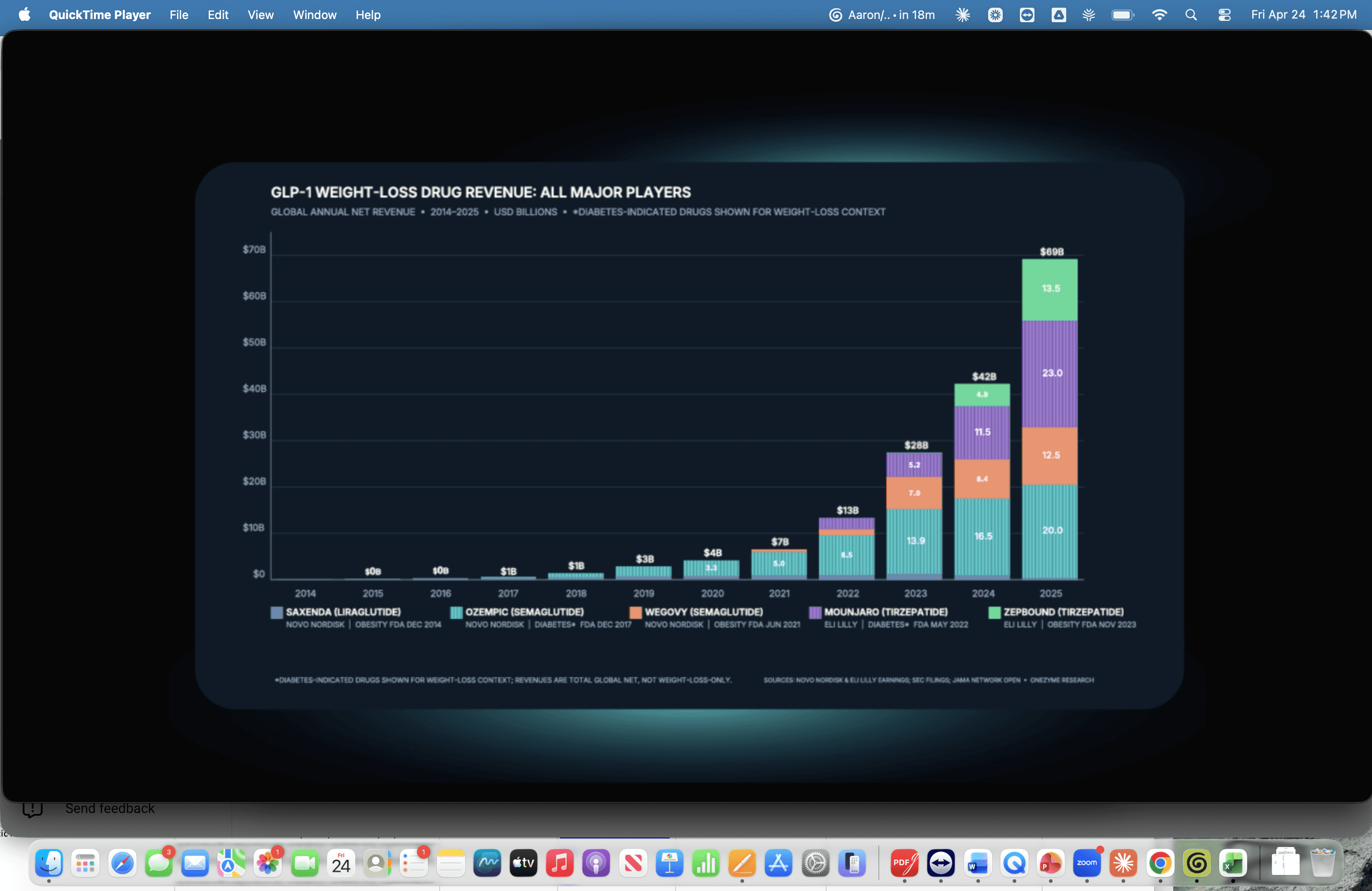
Could One Zyme Have Predicted the GLP-1 Boom in 2014? Our Backtest Says Yes. Here’s What We’d Bet On Now.
In pharma, timing matters almost as much as being right.
The biggest opportunities are usually not obvious when they matter most. By the time a mechanism becomes consensus, the strategic advantage is gone, valuations are inflated, and every major player is already in motion.
That is exactly why we ran a backtest case study on GLP-1s.
Although One Zyme was built in 2025, we asked a simple question in our case study: if One Zyme had existed in 2014, and had access only to the data available at that time, would it have identified GLP-1 receptor agonists as a major future opportunity?
Our answer was yes.
And that leads to the more important question for pharma business development and search-and-evaluation teams today:
What are the equivalent opportunities now?
What One Zyme’s GLP-1 Backtest Found
Using only the information that would have been available in 2014, One Zyme identified GLP-1 receptor agonists as the most promising emerging opportunity in weight loss.
That matters because in 2014, the modern obesity investment thesis was nowhere near consensus among big pharma BD teams. The market had not yet fully absorbed what GLP-1 biology might mean beyond diabetes. Most companies were not behaving as though they were looking at one of the defining drug classes of the next decade.
In hindsight, the signal looks obvious. At the time, it was not.
That is the point.
The GLP-1 story is not just a story about obesity. It is a story about how major pharma markets are born:
early mechanistic signals start to converge
the future market is much larger than most people realize
competitive density is still limited
only a small number of players are taking the opportunity seriously
That combination is what matters. It is the pattern One Zyme is designed to detect.
Why This Matters for Pharma Teams
For business development, competitive intelligence, and new product launch teams, the challenge is rarely a lack of data. It is a lack of timely synthesis.
The real problem is finding the handful of signals that matter before the market prices them in.
One Zyme is built to do that by combining:
global data coverage, including hard-to-access sources
AI-driven synthesis across literature, trials, regulatory activity, patents, and dealmaking
fast conversion of raw signals into decision-ready analysis
pattern recognition before market consensus forms
The GLP-1 backtest is one illustration of that capability.
But the more useful test is whether the same framework can identify the next major white-space opportunities now.
What Is the “Next GLP-1”?
There will probably not be a single literal successor to GLP-1. That is the wrong way to think about it.
The better question is:
Which mechanisms today look most like GLP-1 did before the market fully understood them?
We looked for opportunities with three characteristics:
Strong, replicated mechanistic biology
Blockbuster-scale addressable market
Relatively limited big-pharma crowding due to how early the opportunity is
Using that lens, One Zyme’s top three current “GLP-1-equivalent” white-space opportunities are:
IL-11 pathway blockade
Klotho pathway therapeutics
Antigen-specific immune tolerance platforms
1. IL-11 Pathway Blockade
Why it stands out
IL-11 is emerging as a surprisingly central node across fibrosis, metabolic dysfunction, sarcopenia, cancer biology, and aging.
That is a rare profile. The most interesting platform-like opportunities in pharma are often mechanisms that appear narrow at first, then expand into multiple very large disease areas once the biology becomes clearer.
That is what makes IL-11 compelling.
Why it resembles an early GLP-1 setup
The opportunity combines:
unusually strong mechanistic coherence
applicability across multiple major diseases
relatively low clinical and strategic crowding compared with the breadth of the biology
If the biology continues to hold up, IL-11 could become more than a single-indication drug story. It could become a franchise thesis spanning fibrosis, inflammation, oncology combinations, and potentially aging-related decline.
Why big pharma should care
This is the kind of mechanism where a company can still build a differentiated position before the field becomes crowded. Once that window closes, the cost of entry rises sharply.
2. Klotho Pathway Therapeutics
Why it stands out
Klotho has long been associated with aging biology, but it is now increasingly interesting as a potential cognitive resilience and multi-system health mechanism.
The field has several features sophisticated pharma teams should pay attention to:
deep biological history
human genetic support
encouraging preclinical evidence
a market opportunity that could span neurodegeneration, cognition, kidney disease, and broader aging-related decline
The main risk is translational: Klotho has compelling genetic and preclinical support, but the field still needs clearer answers on delivery, dose-response, biomarkers, durability, tissue specificity, and human efficacy.
Why it resembles an early GLP-1 setup
Klotho is not yet a crowded major-pharma category. That is part of the attraction.
In many of the best white-space opportunities, the science has matured further than market perception has. Klotho appears to fit that pattern. The biology has been building for years, but the asset and franchise implications are still underappreciated.
Why big pharma should care
If the translational bridge continues to strengthen, Klotho could support a category-defining platform around resilience rather than disease-specific symptom management.
That is a big idea. And big ideas matter when they still look early.
3. Antigen-Specific Immune Tolerance
Why it stands out
Antigen-specific immune tolerance aims to retrain the immune system against a specific disease-driving target rather than suppressing the immune system broadly.
That is strategically interesting because it points toward something much larger than incremental autoimmune control. It points toward the possibility of disease-modifying or even functionally curative approaches across major autoimmune categories.
This is a platform class rather than a single pathway, so the pharma Search & Evaluation question is not ‘is tolerance interesting?’ but ‘which delivery modality and antigen-selection strategy is now crossing the translational threshold?’
Why it resembles an early GLP-1 setup
This is not a brand-new concept, but it is still early enough that the field has not yet fully consolidated around winners.
That matters.
Some of the most valuable windows in pharma come after a concept has shown enough proof-of-concept to be credible, but before the market has decided it is inevitable.
That is where antigen-specific tolerance sits today.
Why big pharma should care
If these platforms can deliver durable immune re-education, they could threaten very large chronic biologic markets. That makes the long-term commercial upside enormous.
Why We Did Not Pick the More Obvious “Hot” Areas
One of the most important parts of this exercise was filtering out areas that are scientifically exciting but already too obvious.
That includes mechanisms where:
major acquisitions have already validated the space
multiple big pharma companies are already competing aggressively
valuations have already moved ahead of the real remaining white space
In other words, this was not a search for the most talked-about categories.
It was a search for the most attractive combination of:
strong science
large market
underexploited strategic positioning
That is a different exercise, and a more useful one for S&E teams.
Mechanism | Why now | Evidence level | Competitive density | Main risk | BD/S&E action |
|---|---|---|---|---|---|
IL-11 blockade | Fibrosis + aging biology convergence | Preclinical + early clinical | Medium | Human efficacy, indication selection | Build asset/company watchlist; map IP and China activity |
Klotho | Cognitive resilience and aging biology | Preclinical/NHP + human genetics | Low | Translation, delivery, biomarkers | Monitor emerging platform companies and biomarker readouts |
Antigen-specific tolerance | Potential disease-modifying autoimmune therapy | Mixed clinical/preclinical | Medium | Modality fragmentation, antigen selection | Compare delivery platforms and indication beachheads |
The Deeper Lesson From the GLP-1 Backtest
The GLP-1 story teaches a broader lesson.
The biggest opportunities in pharma usually do not begin as consensus narratives. They begin as scattered signals:
mechanistic clues in the literature
early translational validation
hints of broader applicability
an eventual market that is larger than it first appears
surprisingly little serious competition relative to the upside
That is exactly the kind of pattern that gets lost in fragmented workflows, siloed data, and manual research.
One Zyme is designed to bring those signals together faster and more coherently.
So Could One Zyme Have Predicted GLP-1?
Based on our backtest, yes.
Using 2014-era data, One Zyme identified GLP-1 receptor agonists as the highest-potential emerging opportunity in weight loss before the category became a pharma land grab.
We think that matters not because it proves perfection, but because it demonstrates the right analytic behavior:
finding important signals early
recognizing when the market is underestimating them
distinguishing genuine white space from crowded hype
What Does One Zyme Think the Next GLP-1 Looks Like?
Today, the closest equivalents are not one obvious obesity-like category. They are a set of emerging mechanisms with the same core pattern:
IL-11 pathway blockade for fibrosis, multimorbidity, and potentially aging-related disease
Klotho therapeutics for cognitive resilience, neurodegeneration, and aging biology
Antigen-specific immune tolerance for autoimmune disease and food allergy
These are the kinds of opportunities that matter most before the rest of the market fully agrees.
Why This Matters Now
For pharma leaders, the cost of waiting is high.
By the time a mechanism becomes universally recognized, the best deal structures are gone, asset prices are higher, and internal urgency shifts from opportunity capture to catch-up.
The next GLP-1-level opportunity will not arrive with a label saying so.
It will appear first as an underappreciated pattern in the data.
That is exactly what One Zyme is built to find.
FAQ
What is One Zyme?
One Zyme is an AI-native platform designed for biopharma business development, competitive intelligence, and strategic research. It helps teams identify emerging opportunities by synthesizing global data into decision-ready analysis.
Did One Zyme really backtest GLP-1 using 2014 data?
Yes. One Zyme ran a retrospective analysis using only the information that would have been available in 2014 and identified GLP-1 receptor agonists as the leading emerging opportunity in weight loss.
What does One Zyme think is the next GLP-1?
Based on this analysis, the top white-space opportunities today are IL-11 pathway blockade, Klotho therapeutics, and antigen-specific immune tolerance platforms.
Why are these opportunities important?
Because they combine strong biology, very large potential markets, and lower competitive density than more obvious “hot” areas.
Who is this analysis for?
This is most relevant for pharma business development teams, search-and-evaluation teams, competitive intelligence leaders, and investors trying to identify major therapeutic opportunities before they become consensus.
I'm not able to change fixture relative; everything else is read-only