How AI Partners Solve CRO Revenue Gaps and Win New Mandates
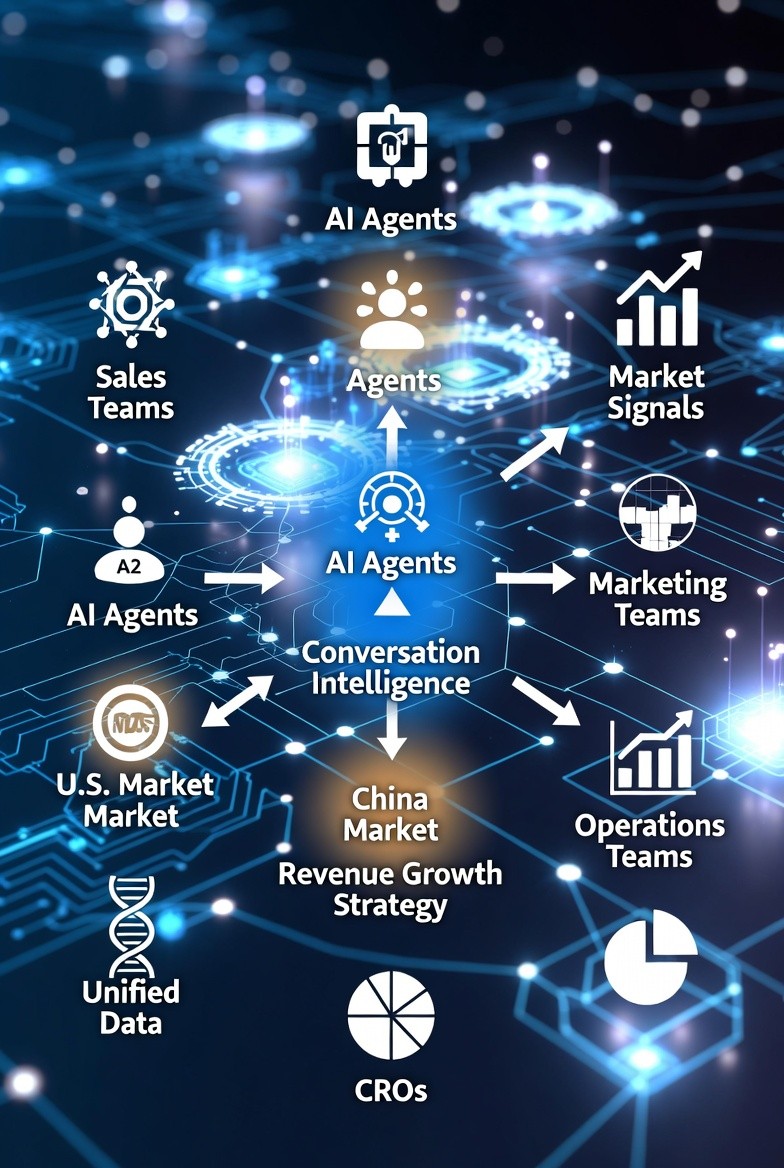
AI sales tools have matured from helpful assistants to revenue engines that deliver predictable growth - especially for biopharma vendors like CROs, CDMOs, and trial site networks. The fastest-moving leaders are partnering with domain-specific, agentic platforms that unify fragmented data, surface high-probability targets, and trigger revenue actions automatically. The result is fewer slipped deals, faster speed-to-lead, and higher win rates. This guide explains where CRO revenue gaps come from, why strategic AI partnerships beat point tools, and how to deploy integrated agents and conversation intelligence to win new mandates. One Zyme’s perspective: AI-native growth intelligence, deeply integrated with commercial workflows across U.S. and China biopharma, is now essential for closing revenue gaps and proving mandate-worthy impact.
Strategic Overview
CROs face a structurally tougher sell than most B2B industries: long cycles, complex stakeholders, stringent compliance, and crowded buyer inboxes. The “best” AI for CRO revenue growth isn’t a single tool; it’s a partner model that combines integrated agents, conversation intelligence, and pragmatic deployments tied to business outcomes. Momentum research argues revenue leaders must evolve from “pipeline operators” to full-stack strategists who direct AI across forecasting, deal execution, and governance, not just lead gen spigots (see Momentum analysis on CROs and AI strategy). The goal: a 24/7 revenue analyst that ingests market signals (funding, pipeline shifts, site activations), prioritizes targets, optimizes outreach, and justifies board-level investments with audit-ready evidence.
The Persistent Revenue Gaps Facing CROs
CROs wrestle with siloed data, manual prospecting, inconsistent forecasting, and reactive selling. Fragmented systems hide key buying signals; spreadsheets slow decisions; and inconsistent call notes undermine pipeline visibility. As a result, reps chase low-fit accounts while high-intent buyers slide to competitors.
Revenue gap defined: the delta between current revenue trajectory and achievable growth given market demand and internal capacity. In CROs, it shows up as stalled pipeline, low conversion rates, and lost renewals—despite strong scientific or operational credentials.
To close this, revenue teams must operate as strategic, AI-enabled systems. As Momentum notes, leaders must shift from pipeline operators to full-stack strategists to drive AI-driven revenue, aligning forecasting, deal execution, and enablement end-to-end (Momentum analysis on CROs and AI strategy).
Why AI Partnerships Are Critical for CRO Growth
Buying a point solution rarely fixes structural revenue leakage. Strategic AI partnerships are different: they bring domain expertise, deep integration, and ongoing success management. In practice, that means shared outcome definitions, unified data flows, and co-owned playbooks that evolve with your portfolio and regions.
Xactly’s research shows AI partners address CRO revenue gaps through predictive risk analysis, improved pipeline visibility, and data-driven insights - while winning new mandates by demonstrating measurable revenue impact and ethical governance (Xactly on AI revenue risk analysis). An AI partnership is a collaborative relationship in which CROs and technology vendors build and iterate together - integrating systems, calibrating models, and tying use cases to sustained growth outcomes.
Key AI Capabilities That Close CRO Revenue Gaps
Core capabilities CROs should expect from a mandate-ready AI partner include:
Integrated AI agents: unify signals across sales, marketing, medical, and ops; trigger next-best actions; reduce leakage.
Conversation intelligence: progressively capture key calls, threads, and meetings; structure insights for forecasting, coaching, and risk management as capabilities mature.
Pragmatic deployments: short sprints tied to revenue KPIs; measurable ROI; clear governance and change management.
Integrated AI Agents for Prioritized Revenue Actions
First-generation AI sales tools are point solutions that often operate in silos; AI agents are emerging as a unified solution that cuts across sales, marketing, and ops functions. That cross-functional scope is crucial for CROs managing complex pursuits and multi-stakeholder governance.
Definition (50 words):
An AI agent is an autonomous, software-driven entity that monitors diverse data sources, reasons over context, and initiates next-best actions inside commercial workflows. It prioritizes accounts, drafts outreach, and monitors your prospects in real time, improving speed-to-lead, forecast accuracy, and win rates while reducing manual effort and leakage risk.
Example signal-to-revenue workflow
Step | Market/Buyer Signal | Agent Reasoning | Automated Action | System(s) | Outcome |
|---|---|---|---|---|---|
1 | New Series B funding | Oncology focus; trial expansion likely | Prioritize account; create pursuit thread | Data lake/CRM | Fast targeting |
2 | Protocol amendment posted | Indication/site needs match CRO strengths | Draft tailored outreach with evidence links | Email/Sales engagement | Relevant contact |
3 | Buying committee expands | Higher risk of stall | Assign exec sponsor; schedule technical deep dive | Calendar/Enablement | Deal momentum |
4 | No reply in 5 days | Engagement risk increasing | Trigger multichannel follow-up; escalate | CRM/Sales engagement | Re-engagement |
5 | Verbal commit | Close-plan gaps persist | Generate mutual close plan; task owners | CRM/Project mgmt | Faster close |
In some CRO environments, the agent can effectively serve as a lightweight CRM layer - handling tracking, monitoring, and alerts when legacy systems cannot support real-time engagement.
Conversation Intelligence as a Strategic Revenue Asset
Conversation intelligence is the process of turning sales calls and engagement touchpoints into structured, analyzable data for revenue optimization. As Forbes notes, the path to AI-driven revenue runs through conversations: conversation intelligence transforms buyer-seller interactions into structured, analyzable revenue data that improves forecasting and deal execution (Forbes council piece on conversation intelligence).
What it can automate:
Auto-log meetings and emails; populate fields; summarize buyer intent
Risk scoring by objection patterns, silence duration, and next-step clarity
Trend visualization across regions, TAs, and buying committees for forecast calls
Pragmatic and Outcome-Focused AI Deployments
AI-washing is the practice of branding software as “AI” without delivering measurable workflow impact. Avoid it by anchoring every sprint to revenue proof. As Peter Mollins notes, CROs want practical AI: show three places AI can help close more revenue this quarter (commentary on CROs under pressure to have an AI strategy).
A 30-day sprint pattern:
Week 1: Select one high-value use case (e.g., oncology account surge detection); define KPIs (cycle time, touch depth, next-step adherence).
Week 2: Connect core data sources; calibrate agent prompts and CI taxonomies; run A/B motion.
Week 3: Operate in prod; instrument dashboards; coach to insights.
Week 4: Present ROI; decide whether to scale/iterate or expand to a second motion.
Trends Shaping AI Adoption in CRO Commercial Strategies
GTM orchestration, RevOps alignment, and pipeline forecasting are converging as one motion. CROs that unite data across marketing, KAMs, BD, and delivery are pulling ahead. Expect rapid adoption of agentic AI that spans pre-sales to handoff - especially where privacy, evidence lineage, and audit trails are non-negotiable in life sciences.
CRO and CIO Alignment for Scalable AI Integration
Deep alignment between revenue and technology leaders is the unlock. Clari argues AI can’t fix revenue alone; tight CRO-CIO alignment ensures unified data, security, and adoption (Clari analysis on CRO-CIO alignment).
CRO-CIO alignment defined: the practice of close collaboration between revenue and IT leaders to unify data, harden security, and drive adoption of commercial technology.
Aligned orgs: Shared data model; faster cycle times; higher forecast accuracy; lower change-management friction.
Siloed orgs: Duplicative tools; data drift; security risk; low adoption and stalled ROI.
From AI Assistants to Autonomous Revenue Agents
Assistants automate tasks for individuals; agents increasingly coordinate cross-system workflows for teams. G2’s analysis emphasizes effectiveness over mere efficiency and notes assistants fit SMB reps, while agents deliver enterprise-scale impact (G2 guide on AI-washing in sales). Most enterprise deployments today uplevel team efficiency and enable faster decision-making, with greater autonomy introduced over time as governance and controls mature.
Agentic AI defined: autonomous software that initiates and coordinates actions across multiple systems and teams to manage revenue end-to-end.
Assistant vs. agent
Dimension | Assistant | Agent |
|---|---|---|
Scope | Single user/task | Coordinated team workflow |
Actions | Suggest/compose | Recommend/coordinate/controlled execute |
Systems | One or two | Many (CRM, engagement, analytics) |
Impact | Efficiency | Effectiveness and outcomes |
Fit | SMB/individual | Mid-market/enterprise CROs |
Partner-Enabled Revenue Growth Models
Mature AI partners accelerate adoption, fill capability gaps, and make revenue outcomes repeatable. In a global survey, over 25% of partners expect 76–100% of revenue to come from AI-related tech within 4–5 years (Cisco partner survey on AI revenue shift). And 90% of solution providers are optimistic AI will materially impact their business in the next 12–18 months (CRN research on rising AI revenue impact).
Partner benefits snapshot
Benefit | What it looks like |
|---|---|
Upskilling | Role-based enablement and playbooks |
Tech integration | Secure connectors; real-time pipelines |
Data governance | PII minimization; lineage; audit trails |
Ongoing optimization | Quarterly model tuning and GTM updates |
Addressing Risks of AI-Washing in Sales
Efficiency isn’t the endgame—effectiveness is (G2 guide on AI-washing in sales). Evaluate like a board member.
Red flags:
No measurable revenue KPIs; vanity metrics only
Shallow integrations; CSV imports as “integration”
Generic models with no life-sciences context
Positive signals:
Verified ROI within 30–60 days; customer references
Deep CRM/engagement/BI integration and data lineage
High adoption with workflow-native UX and enablement
How AI Partners Help CROs Win New Mandates
Proven AI platforms don’t just plug revenue leaks - they strengthen your commercial narrative. Microsoft leadership observes companies that operationalize AI strategies are more likely to see revenue growth alongside productivity, margin, and cost improvements (Microsoft leadership on AI and revenue growth). For CROs, that story resonates with biopharma sponsors who demand faster startup, better enrollment predictability, and audit-ready governance.
Outcome examples:
Reduce churn by forecasting renewal risk from engagement gaps and budget signals; trigger executive saves.
Improve headcount planning by matching territory potential to rep capacity; redeploy toward high-probability TAs.
Optimize incentives by aligning comp to verified influence on multi-threaded pursuits across sales and finance.
AI-enabled vs. manual mandate pursuit
Criterion | Manual | AI-enabled |
|---|---|---|
Targeting | Static TAM lists | Live, evidence-linked ICP and intent |
Deal velocity | Unpredictable | Risk-aware close plans and escalations |
Forecasting | Opinion-driven | Signal-driven, auditable |
Sponsor confidence | Claims | Measured revenue impact and governance proof |
Demonstrating Measurable Revenue Impact Quickly
Boards and sponsors fund what they can measure. Enterprises implementing AI are closing new-logo deals 20% faster than two years ago, per Clari’s analysis (Clari analysis on CRO-CIO alignment). Complement speed with accuracy and capture metrics.
Suggested KPIs to prove in 30–60 days:
New-logo cycle time reduction (Clari analysis on CRO-CIO alignment)
Forecast accuracy and risk detection lift (Xactly on AI revenue risk analysis)
Improvement in call-to-CRM capture rate and next-step adherence as conversation intelligence matures (Forbes council piece on conversation intelligence)
KPI summary
KPI | Baseline | 30–60 day target | Evidence source |
|---|---|---|---|
New-logo cycle time | Current average | −10–20% | Clari |
Forecast accuracy | Current variance | Material variance reduction | Xactly |
Data capture rate | Manual logging | Automatic, near-complete capture | Forbes CI analysis |
Delivering Integration and Governance Confidence
In regulated markets, trust is currency. Yet 62% of partners cite inexperience deploying new tech as a top AI adoption challenge (Cisco partner survey on AI revenue shift). Ethical AI governance - transparent, unbiased, and compliant decision-making - is non-negotiable in life sciences.
Required partner deliverables:
Data integration plan with lineage, minimization, and residency controls
Workflow mapping from signal to action
Security posture and ethical AI documentation (bias testing, human-in-the-loop)
Transforming Pilots into Repeatable Commercial Success
ARR is annual recurring revenue, the SaaS metric for predictable, contractually committed revenue. To scale ARR, convert pilots into playbooks: a sequenced set of steps that replicate proven outcomes across teams and regions.
Example scale flow:
Pilot: One TA, one region, one workflow
ROI proof: Quantified KPI lift and sponsor references
Playbook design: Roles, metrics, governance, training
Rollout: Cross-team expansion; quarterly tuning; executive QBRs
Implications for CROs and Their Technology Partners
Selecting the right AI partner is a commercial decision, not just an IT choice. Demand domain expertise, deep integrations, verified ROI, and change-management strength. CRO must-haves when vetting AI-native platforms:
Live, multi-source data unification with evidence-linked insights
Agentic orchestration across CRM, engagement, BI, and finance
Life-sciences–specific models and governance controls
Sprint-based deployments with measurable revenue KPIs
CROs must lead AI strategy -not delegate it to IT or RevOps - to create repeatable, outcome-aligned systems (Momentum analysis on CROs and AI strategy). One Zyme’s approach: a 24/7 AI revenue analyst purpose-built for biopharma vendors, unifying market signals and commercial execution to grow mandates across U.S. and China.
Future Outlook for AI-Driven CRO Revenue Growth
The next horizon is fully agentic, outcomes-driven revenue platforms that compress time from signal to engagement, raise forecast fidelity, and scale pipeline growth with fewer surprises. Integrated data and AI are mission-critical for revenue leaders who need to move first and pivot fast. CROs that operationalize agents and conversation intelligence - backed by ethical governance - will emerge as first movers in a fragmented, reactive market.
Frequently asked questions
How does AI predict and mitigate revenue risks for CROs?
AI analyzes deal activity, buyer behavior, and pipeline signals to flag early risk or slippage, enabling targeted interventions that prevent end-of-quarter surprises.
What measurable benefits can CROs expect from AI partnerships?
Expect faster deal cycles, higher win rates, better CRM data quality, and improved pipeline conversion when AI is integrated into daily workflows and measured against clear KPIs.
Why is ethical AI governance important in sales operations?
It ensures automated decisions are transparent, unbiased, and compliant—critical for life sciences where audit trails and patient-adjacent data require strict controls.
How does AI improve alignment between sales, finance, and RevOps?
AI unifies data and establishes a shared truth for pipelines and forecasts, reducing disputes and aligning resources, incentives, and headcount plans.
What practical steps ensure AI tools deliver sustained pipeline lift?
Start with a focused pilot, measure ROI within 30–60 days, integrate deeply with core systems, then scale proven playbooks across teams with ongoing tuning.-
I'm not able to change fixture relative; everything else is read-only