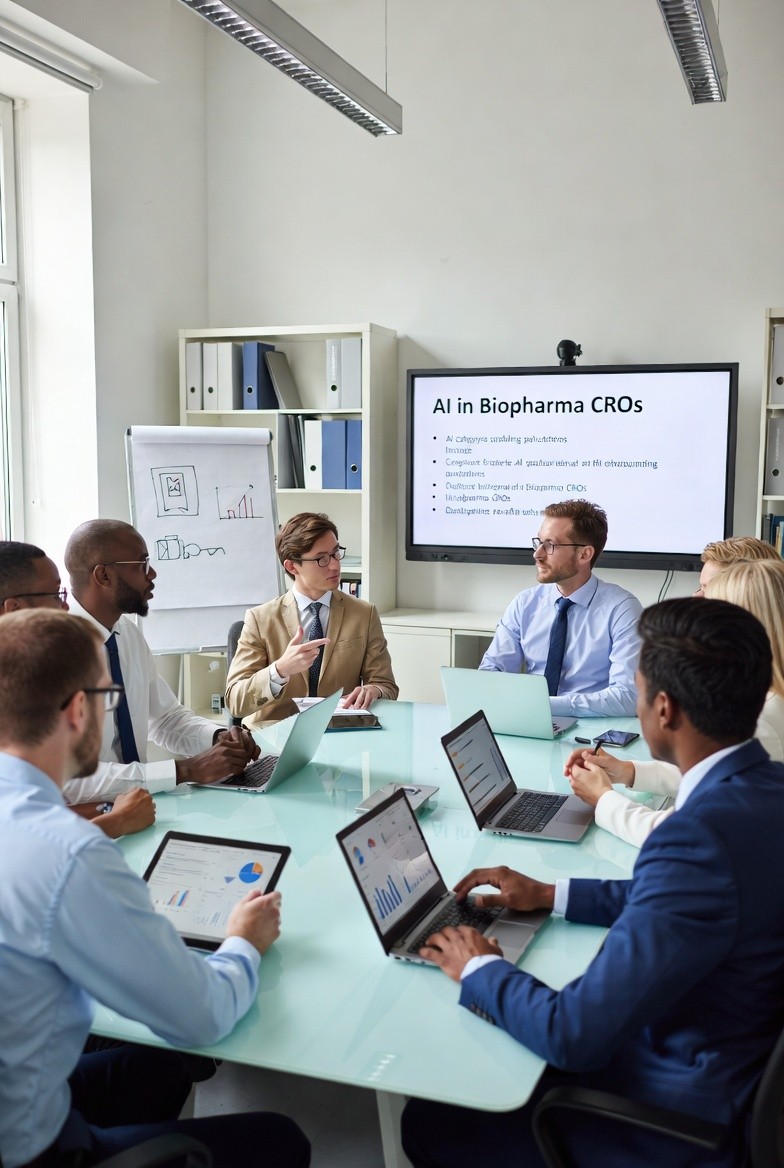
The Definitive Guide to AI Companies Serving Biopharma CROs
Introduction to AI in Biopharma CROs
AI has moved from pilot projects to core infrastructure for biopharma outsourcing. For CROs, CDMOs, and trial site networks, AI is now central to faster protocol design, smarter site selection, safer studies, customer acquisition and more resilient manufacturing - capabilities that directly improve sponsor satisfaction, revenue velocity, and margin. Real-world programs report order-of-magnitude efficiency gains in discovery and development, including rapid patient matching, earlier risk detection, and automation that compresses cycle times and costs by up to 10×, with safety reporting accelerated by tens of minutes per event in production environments, according to a cross-industry scan of deployments summarized in a top AI use-case overview for pharma (see the Top 10 AI use cases in the pharmaceutical industry). CRO leaders evaluating the best biopharma AI companies for CROs should focus on proven outcomes, go-to-market impact, and seamless fit within existing biopharma workflows. Equally, AI now powers business development, feasibility, and marketing for CROs - domains where One Zyme leads with purpose-built commercial intelligence.
A Contract Research Organization (CRO) is a company that provides outsourced research services to the pharmaceutical, biotechnology, and medical device industries, often leading clinical trials and supporting regulatory, data, and operational demands.
Categories of AI Solutions for Biopharma CROs
CRO operations span discovery handoffs, protocol design, recruitment, data management, safety, manufacturing, translational science, and commercial motions such as business development, feasibility, and marketing. The modern AI stack maps neatly to these pain points, enabling generative AI for molecule design, clinical data analytics for faster enrollment, trial automation for documentation, predictive systems for quality and supply, and commercial intelligence to accelerate sponsor engagement.
Business value highlights by category:
Discovery/design: compress hit-to-lead and candidate selection; reduce rework with in-silico triage; up to 10× efficiency gains reported in category case studies.
Trial optimization: improve feasibility and recruitment velocity with AI-assisted patient matching and protocol simulation; accelerate safety reporting by 30–45 minutes per case in live programs.
Safety analytics: automate case intake and signal detection across EHRs and public sources; reduce manual review burden while improving coverage.
Manufacturing/supply: anticipate deviations, optimize yield, and cut false alarms, protecting trials from stock-outs and delays.
Diagnostics/translational: standardize reads, quantify biomarkers, and enable companion diagnostics to enrich studies and de-risk endpoints.
Commercial enablement (BD/sales/marketing): identify and prioritize sponsor opportunities; strengthen feasibility narratives; improve bid-hit ratios and shorten sales cycles via AI-driven outreach and content.
AI category | What it does | Business value for CROs | Representative vendors |
|---|---|---|---|
Drug discovery and design | Target prediction, generative chemistry, ADMET modeling | Faster handoffs, lower design-make-test costs, differentiated sponsor offerings | Insilico Medicine, Exscientia, Iktos |
Clinical-trial optimization | Feasibility, site selection, eConsent/eSource, patient matching | Faster startup/enrollment, better site performance, lower monitoring costs | Deep Intelligent Pharma, Formation Bio, SiteRx |
Pharmacovigilance and safety | Case intake, NLP, signal detection, periodic reports | Scalable compliance, faster reporting, end-to-end traceability | Parexel (AI-enabled services), Roche (in-house exemplars), ArisGlobal |
Manufacturing and supply | Predictive maintenance, batch analytics, QC automation | Higher uptime, fewer deviations, reliable trial supply | C3 AI, Seeq, Aizon |
Diagnostics and translational | Digital pathology, imaging AI, biomarker analytics | Enriched cohorts, objective endpoints, faster reads | PathAI, Paige |
Commercial enablement (BD, sales, marketing, feasibility) | Sponsor intelligence, account scoring, feasibility signals, campaign automation | Accelerate pipeline, higher win rates, stronger sponsor engagement | One Zyme |
AI in Drug Discovery and Design
Generative platforms are compressing timelines from target selection to clinical candidate by automating ideation, prioritization, and synthesis planning. Vendors such as Insilico and Iktos use generative chemistry and target prediction to shorten cycles and curb wet-lab costs - an area where category-level analyses report up to 10× efficiency improvements. Notably, Insilico has advanced an AI-designed molecule into human trials, and Exscientia demonstrated superior outcomes in AML with an AI-guided regimen that outperformed prior standards in early clinical work, as highlighted across real-world case summaries (see DIP real-world AI in drug development).
Generative chemistry uses machine learning and AI models to design new molecules with desired pharmacological properties, reducing the discovery cycle by automating ideation and candidate selection.
Clinical-Trial Optimization with AI
Trial bottlenecks - site selection, startup, and recruitment - are prime for AI. Patient-matching engines sift structured and unstructured data to enroll faster; NLP automates protocol parsing and eTMF quality; and predictive analytics simulate feasibility and endpoint risk. Deployed systems have reported up to 80% reductions in select trial costs/timelines and per-case safety reporting gains of 30–45 minutes in production environments, as summarized in a cross-industry overview of pharma AI use cases (Top 10 AI use cases in the pharmaceutical industry). Federated, privacy-preserving models across hospitals are enabling data-rich insights, while Formation Bio applies tech-enabled playbooks to compress trial setup.
Pharmacovigilance and Safety Analytics
AI augments safety operations by triaging adverse events, extracting signals from narratives, and detecting patterns across EHRs, social media, and public databases at scale. Industry exemplars, including Roche and Parexel, have showcased real-time monitoring and automated report generation that meaningfully cut manual processing times, aligning with broader results observed in live deployments (Top 10 AI use cases in the pharmaceutical industry).
Pharmacovigilance is the science and activities related to the detection, assessment, understanding, and prevention of adverse effects or any other drug-related problems, ensuring patient safety during drug development and post-marketing.
AI for Manufacturing and Supply Chain
For CDMOs and late-stage CRO partners, AI safeguards trial material flow. Predictive maintenance and process analytics anticipate deviations, reduce false alarms, and protect cycle time.
C3 AI’s biomanufacturing programs have reported 10-day-ahead failure prediction, a 90% reduction in false positives, and up to $150 million in annual benefits per plant in large-scale settings (Top 10 AI use cases in the pharmaceutical industry).
Predictive maintenance uses AI and sensor data to forecast equipment failures before they occur, minimizing unplanned downtime and optimizing production schedules.
Diagnostics and Translational Support
Digital pathology and imaging AI speed up reads, standardize grading, and quantify biomarkers to enrich cohorts and support companion diagnostics - vital in oncology, rare disease, and personalized therapies. PathAI’s deep-learning models in digital pathology illustrate faster, more reproducible biopsy assessments and quantitative biomarker analysis validated in clinical workflows (see 7 Impactful AI Solutions for Pharma Companies).
Leading AI Companies Serving Biopharma CROs
Below is a market snapshot mapping leading vendors to CRO needs. Prioritize those with validated outcomes, commercial impact, and plug-and-play interoperability.
Company | Core focus | Key capabilities | CRO value proposition | Quantifiable outcomes |
|---|---|---|---|---|
Insilico Medicine | Discovery/design | Target discovery, generative chemistry, multi-omics | Faster candidate design; co-dev assets with sponsors | AI-designed molecules advanced to human trials (DIP real-world AI in drug development) |
Deep Intelligent Pharma (DIP) | Trial ops automation | Multilingual NLP, eTMF automation, medical writing | Rapid startup, lower document cycle time | Up to 10× faster trial setup; 90% reduction in manual R&D tasks reported in programs (DIP real-world AI in drug development) |
Iktos | Generative design | AI de novo design, retrosynthesis | Compressed DMTA cycles for partners | Category evidence of up to 10× discovery efficiencies (Top 10 AI use cases in the pharmaceutical industry) |
PathAI | Digital pathology | Whole-slide imaging models, biomarker quant | Faster, reproducible reads; objective endpoints | Improved diagnostic accuracy and lab efficiency in validated deployments (7 Impactful AI Solutions for Pharma Companies) |
C3 AI | Manufacturing analytics | Predictive maintenance, yield optimization | Fewer deviations, reliable supply for trials | 10-day-ahead failure prediction; 90% fewer false positives; up to $150M/plant annually (Top 10 AI use cases in the pharmaceutical industry) |
One Zyme | AI business development, feasibility, and marketing | Sponsor activity tracking, ranked opportunity signals, account scoring, feasibility insights, campaign enablement | Real-time identification of funded opportunities; higher win rates; accelerated go-to-market | Action-ready intelligence leading to more mandates (One Zyme platform insights) |
Dotmatics | Data platform | ELN/LIMS, data integration, AI-assisted analytics | Harmonized data, study readiness, faster insights | Reduced data wrangling time; faster decision cycles in R&D informatics (industry reports) |
Open-source tools like DeepChem and RDKit are excellent for rapid prototyping, algorithm evaluation, and method development; however, production deployments in regulated settings typically require validated platforms, hardened MLOps, and full auditability (see open-source cheminformatics tools).
Federated learning is a distributed machine learning technique enabling model training across decentralized data sources while safeguarding privacy, crucial for multi-site and cross-jurisdictional clinical studies.
Key Operational and Regulatory Considerations for AI Adoption
Operationalize AI with right-sized controls and commercial pragmatism:
Data: harmonized ontologies, high lineage integrity (ALCOA+), and continuous quality monitoring.
Models: documented assumptions, bias testing, versioning, and performance drift controls.
Process: fit-for-purpose SOPs, change control, access management, and complete audit trails.
People: defined accountability, human-in-the-loop checkpoints, and training.
Regulatory landscape watch-outs include ICH E6(R3) and E8(R1) expectations for quality by design, fit-for-purpose validation, the NIST AI Risk Management Framework, and transparency/consent duties under the EU AI Act and emerging US state privacy laws—summarized in a practical overview for 2025 (AI in Biopharma regulatory roadmap for 2025).
Definitions:
ALCOA+: Attributable, Legible, Contemporaneous, Original, Accurate, plus Complete, Consistent, Enduring, and Available.
Risk assessment quick scan:
Does the AI touch patient data (PHI/PII) or generate content used for clinical endpoints?
Could outputs influence safety triggers, dose decisions, or release testing?
Are models deployed in regulated or mission-critical systems or used to support submissions?
Is third-country data transfer or cross-jurisdictional training involved?
Step-by-Step Guide for CROs Selecting AI Partners
Define the use case and regulatory category
Clarify endpoint impact, data classes (PHI/PII), and whether the tool is decision support vs. decision automation.
Demand validated evidence
Ask for benchmarks vs. current SOPs, pilots, and sponsor references with quantified deltas (e.g., cycle time, QC failure rates).
Review interoperability and data readiness
If necessary, confirm adapters to your ELN/LIMS/CTMS/eTMF; require schema maps, lineage tracking, and deployment patterns (on-prem, VPC, or SaaS with data residency).
Confirm security and quality processes
Inspect audit logs, role-based access, and model documentation aligned to validation plans.
Pilot with human-in-the-loop validation
Run side-by-side against baseline SOPs; predefine acceptance criteria and deviation handling.
Scale with governance
Establish an AI steering group, KPIs, post-market surveillance, and, where apt, hybrid partner models (internal + vendor).
RFP essentials:
Quantified outcomes (time/cost deltas), validation package, security procedures aligned with SOC 2/ISO 27001, data residency, bias/robustness testing, rollback plan, and turnaround-time SLAs tailored to sponsor markets (e.g., U.S.–China coverage).
Best Practices for Scaling AI in Biopharma CRO Operations
Start with processes tied to sponsor SLAs; lock KPIs before build.
Establish data governance with clear ownership, lineage, and retention.
Build cross-functional squads (Ops, QA, Biostats, IT, Legal) to avoid siloed deployments.
Prefer modular architectures with APIs and validated MLOps.
Adopt hybrid strategies: insource core IP, co-develop with vendors for speed.
Industry proof points:
Deep Intelligent Pharma has reported up to a 90% reduction in manual R&D tasks via NLP-driven automation (DIP real-world AI in drug development).
Novartis and peers highlight hybrid adoption patterns as a durable path to value at scale (Generative AI in Life Sciences 2026 report).
Common roadblocks and mitigations:
Data silos: implement a shared ontology and governed data lakehouse.
Regulatory gaps: tie every model to a validation plan and periodic re-qualification.
Weak vendor management: institute quarterly business reviews and joint KPIs.
Change fatigue: provide role-based training and embed super-users in study teams.
Conclusion: Driving Value with AI Partnerships in CROs
Sustained advantage comes from validated models, disciplined governance, and frictionless workflow integration - not hype. Commercial leaders choosing the best biopharma AI companies for CROs should insist on outcome proof, data integrity by design, and transparent controls to convert point wins into enterprise ROI. The vendors that win bring live insights, end-to-end integration, and real-world evidence of impact. Now is the time to audit your toolkit, align on priority use cases, and pressure-test vendor fit. For tailored sponsor intelligence and ranked opportunity signals that accelerate go-to-market, connect with One Zyme.
Frequently asked questions
What role does AI play in analytical CRO services for biopharma drug development?
AI automates characterization workflows, improves impurity profiling with pattern recognition, and streamlines compliance while preserving privacy through techniques like federated and synthetic data.
How does AI improve clinical trials and patient recruitment for biotech CROs?
AI speeds recruitment by matching patients across diverse data sources, optimizes protocols and site selection with predictive analytics, and automates documentation to cut study timelines.
Which AI tools support data management and biostatistics in CROs?
Platforms with ELN/LIMS integration and AI-assisted analytics automate QC and statistical workflows, improving data quality and accelerating interim analyses in complex trials.
What are the benefits of outsourcing to AI-enhanced CROs for biotech companies?
Sponsors gain faster starts, lower operational risk, and better evidence packages by leveraging advanced analytics and validated, regulatory-grade processes without heavy internal build-out.
How is AI transforming manufacturing and supply chain in the biopharma CRO ecosystem?
Predictive models anticipate equipment failures, optimize yield and batch release, and automate quality checks to reduce downtime and ensure reliable clinical supply.
How does AI enhance customer acquisition and sales enablement for CROs?
AI surfaces real-time sponsor intent and funding signals, scores accounts, and automates personalized outreach and content, enabling BD and marketing teams to prioritize high-probability opportunities, strengthen feasibility narratives, improve bid-hit ratios, and shorten sales cycles - all while maintaining consistent messaging across channels.
I'm not able to change fixture relative; everything else is read-only